

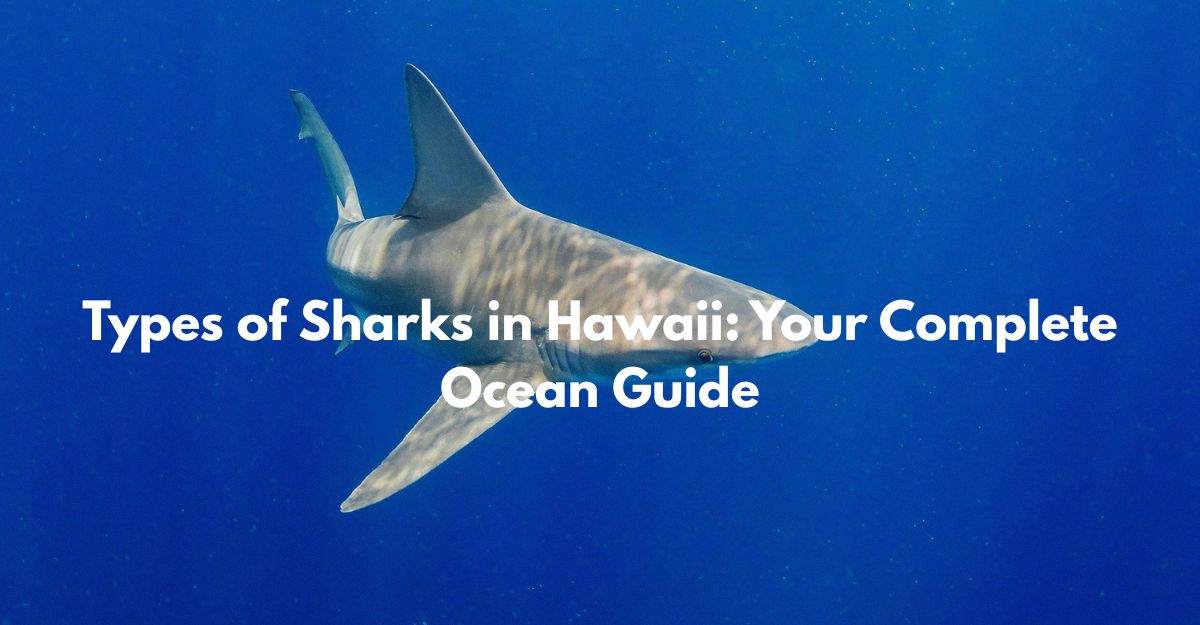
Imagine you are snorkeling in the crystal-clear waters of Maui. The coral reef glitters below you. Then, out of the blue, a sleek shadow glides past. Your heart races for a second. But then you realize it is just a blacktip reef shark, one of the most harmless and beautiful creatures in the ocean.
Hawaii is one of the most shark-rich places on the planet. Over 40 species of sharks call Hawaiian waters home. Some are tiny. Some are enormous.
Understanding the types of sharks in Hawaii takes the fear away and replaces it with wonder. These animals have swum these Pacific waters for millions of years. They are not villains. They are vital.
This guide covers everything you need to know about the most common types of sharks in Hawaii, their behavior, their size, and how to safely enjoy the ocean alongside them.
Why Hawaii Is a Shark Paradise
Hawaii sits right in the middle of the Pacific Ocean. The islands offer warm tropical waters, thriving coral reefs, deep ocean trenches, and an abundance of prey. This combination makes Hawaii one of the richest shark habitats in the world.
Sharks thrive in Hawaii because the ecosystem gives them everything they need. Coral reefs shelter small fish. Open ocean currents bring in larger prey. Warm temperatures support year-round activity.
Hawaii’s waters also stay clean and rich in oxygen. This supports a wide variety of marine life, which in turn supports a wide variety of shark species.
The types of sharks in Hawaii range from tiny deep-sea dwellers to powerful apex predators. Each species fills a unique role in the ocean’s food web.
Without sharks, entire ecosystems can collapse. They keep fish populations balanced, remove sick and injured animals, and support the overall health of the reef.
The 8 Most Common Types of Sharks in Hawaii
Hawaii’s Department of Land and Natural Resources officially recognizes eight shark species as the most commonly encountered in Hawaiian waters.
| Shark Species | Average Size | Danger Level | Common Location |
| Tiger Shark | 10 to 14 feet | High | Coastal waters, all islands |
| Galapagos Shark | 8 to 10 feet | Moderate | Reefs, Northwestern islands |
| Gray Reef Shark | 4 to 6 feet | Low to Moderate | Reef edges, deep currents |
| Blacktip Reef Shark | Under 5 feet | Very Low | Shallow lagoons, reef flats |
| Sandbar Shark | 6 to 8 feet | Very Low | Sandy bottoms, channels |
| Scalloped Hammerhead | 7 to 14 feet | Low | Offshore, seamounts |
| Smooth Hammerhead | 8 to 13 feet | Low to Moderate | Deeper reef areas, offshore |
| Whitetip Reef Shark | Under 5 feet | Very Low | Reef crevices, ocean floor |
Tiger Shark: Hawaii’s Most Powerful Predator
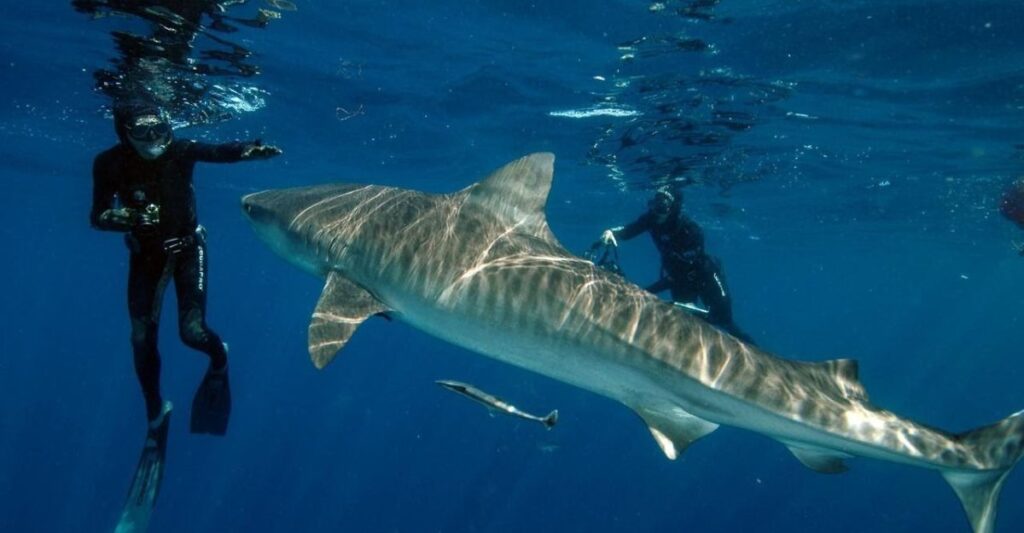
The tiger shark is the most well-known of all the types of sharks in Hawaii. Its Hawaiian name is niuhi, which means “the man-eater that comes secretly.”
Tiger sharks can grow up to 14 feet long and weigh close to 1,900 pounds. Their bodies are grayish-brown with dark stripes that fade as they grow older. Young tiger sharks have bold markings. Adult tiger sharks develop a more uniform color.
What makes the tiger shark stand out is its incredibly varied diet. These sharks eat fish, sea turtles, birds, dolphins, rays, and even garbage. They are highly opportunistic. This adaptability has helped them thrive in Hawaiian waters for thousands of years.
Tiger sharks are active mainly at night. They patrol coastal areas, bays, and reef drop-offs.
They are responsible for most serious shark incidents in Hawaii. Still, actual attacks remain very rare given how many people enter Hawaiian waters every year. They are curious, powerful animals that sometimes mistake swimmers for prey.
You are most likely to spot tiger sharks around Maui, Oahu, and the Big Island. They move between shallow coastal zones and deeper offshore waters depending on prey availability.
Galapagos Shark: The Curious Coastal Cruiser
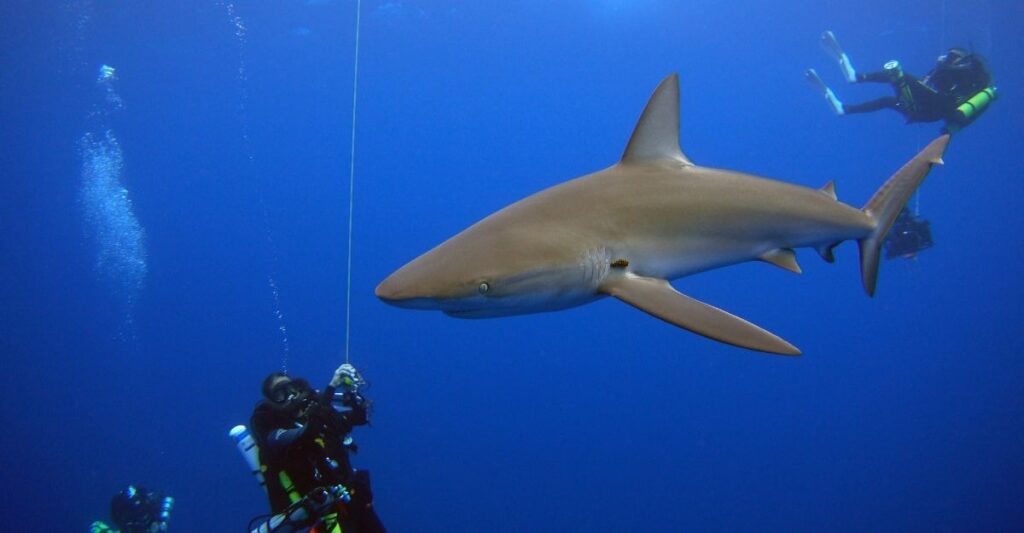
The Galapagos shark is one of the larger types of sharks in Hawaii. These sharks have a stout, robust body with a short rounded snout and large triangular-shaped pectoral fins.
Their coloring ranges from dark gray on top to white on the underside. They are common around the Northwestern Hawaiian Islands but also appear near the main islands.
Galapagos sharks are known for their curiosity around humans. They often show up near fishing boats in large groups and investigate activity without showing aggression.
One interesting fact about the Galapagos shark is that it sometimes eats its own kind. Larger individuals will consume smaller Galapagos sharks when food is scarce.
Conservation wise, the Galapagos shark is currently listed as Near Threatened by the International Union for Conservation of Nature. Bycatch, habitat degradation, and fishing pressures continue to affect their population numbers.
Blacktip Reef Shark: The Reef’s Friendly Resident
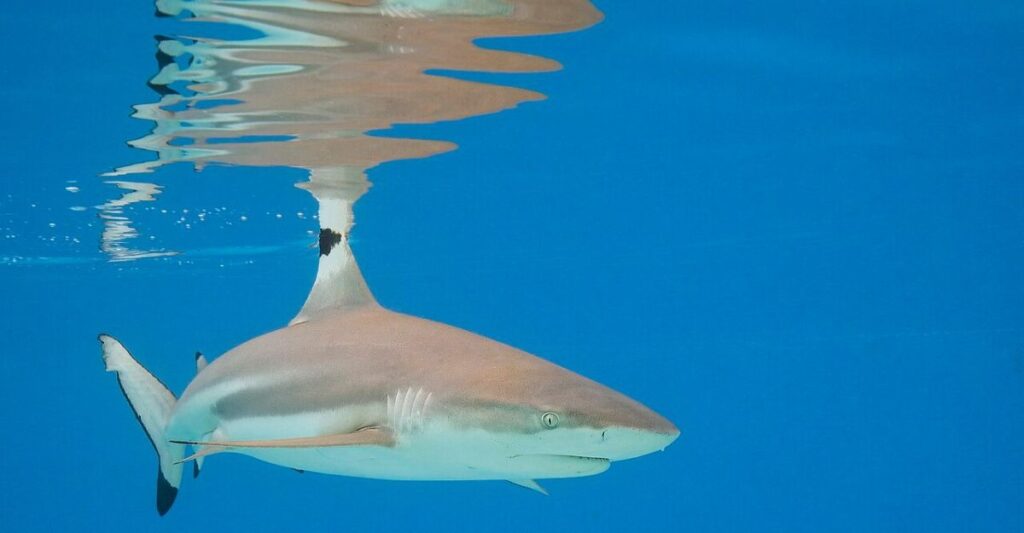
The blacktip reef shark is perhaps the most commonly spotted of all the types of sharks in Hawaii for snorkelers and swimmers. Its Hawaiian name is manō pa’ele.
These sharks are slender and streamlined. They rarely exceed 5 feet in length. Their most distinctive feature is the bold black tips on their fins. Their bodies range from grayish to brownish-green on top and white on the underside.
Blacktip reef sharks love shallow water. You can often spot them near sandy beaches, coral reef flats, and lagoons with their dorsal fins breaking the surface.
They are not aggressive toward humans at all. In fact, they tend to swim away quickly when they sense noise or activity nearby. Most bites from blacktip reef sharks happen when people accidentally startle them by wading through shallow water rather than swimming properly.
Their diet consists mainly of small reef fish like sardines, mullet, and anchovies. They also eat crustaceans and squid.
Blacktip reef sharks play a vital role in keeping reef ecosystems balanced by controlling smaller fish populations. They are currently classified as Near Threatened due to overfishing and habitat loss.
Gray Reef Shark: The Reef’s Bold Patrol Officer
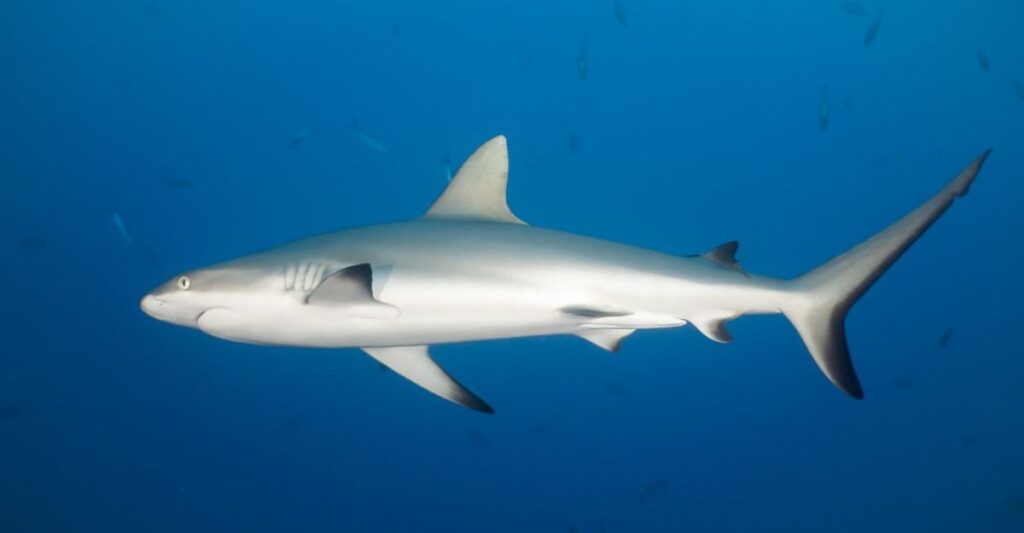
The gray reef shark is one of the more aggressive types of sharks in Hawaii when it comes to interactions with divers. It does not usually attack without reason, but it does get defensive when it feels cornered.
Gray reef sharks grow to about 6 feet on average. They have a gray body with a white belly and a subtle dark margin along the edge of their tail fin. They do not have an inter-dorsal ridge, which helps identify them from similar species.
These sharks are active both day and night. At night, they tend to travel longer distances. During the day, they patrol reef edges and strong current areas in the Northwestern Hawaiian Islands.
They are socially active animals. You may see them swimming in groups, and they sometimes display a distinctive threat posture when stressed: arching the back, dropping the pectoral fins, and swimming in a figure-eight motion. If you see this behavior, back away slowly.
Gray reef sharks feed on fish, squid, crustaceans, and other marine invertebrates. Larger predators like tiger sharks and great hammerhead sharks prey on them.
Sandbar Shark: The Sandy Bottom Specialist
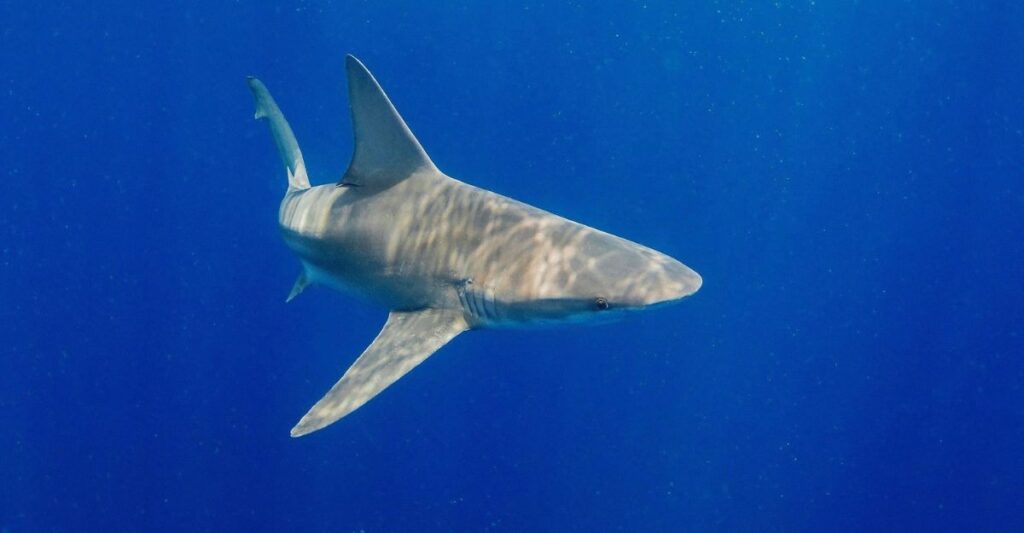
The sandbar shark is one of the most widespread types of sharks in Hawaii in coastal waters. It is also called the brown shark or ground shark.
Sandbar sharks grow up to 8 feet long. One of their most distinct features is a very tall, triangular first dorsal fin. They also have a more compact, rounded snout compared to other requiem sharks. Their color is gray-brown on top and white below.
These sharks prefer shallow coastal areas, sandy flats, and channels between reef systems. Females tend to stay in shallower zones. The species typically cruises at depths ranging from 30 to 900 feet.
Sandbar sharks are gentle around humans. They rarely approach swimmers and do not show aggressive behavior. Divers who encounter them often describe them as calm and indifferent.
They feed mainly on bony fish like tuna, herring, and mackerel. They also eat squid, octopus, and lobsters near reef areas.
The sandbar shark is classified as Vulnerable by the IUCN. Overfishing for meat, fins, and liver oil has reduced their numbers. Hawaiian fishing regulations now help protect this species and support its recovery.
Scalloped Hammerhead Shark: Hawaii’s Iconic Silhouette
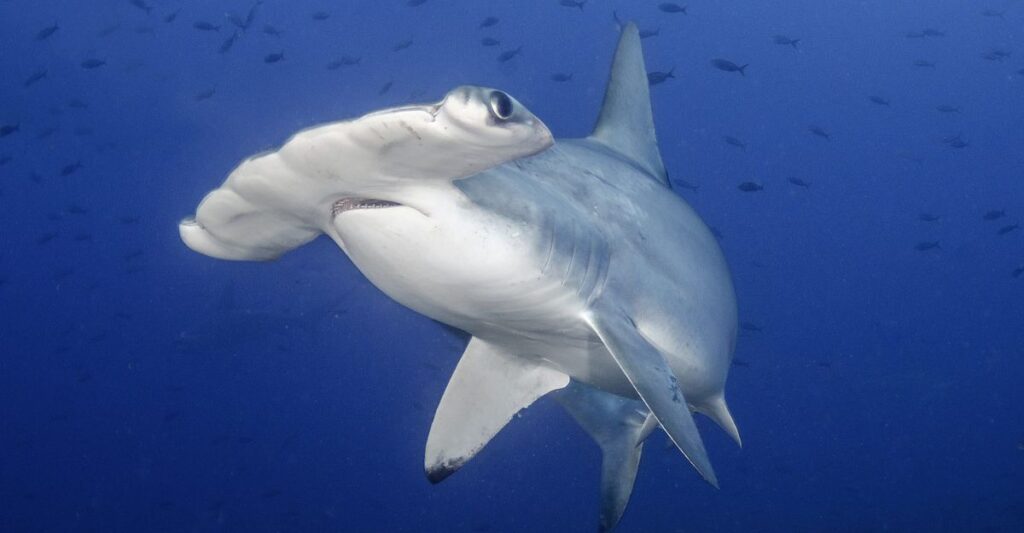
When people imagine a hammerhead, they usually picture the scalloped hammerhead, one of the most recognizable types of sharks in Hawaii. Its Hawaiian name is manō kihikihi.
The scalloped hammerhead gets its name from the wavy, scalloped front edge of its hammer-shaped head. This head shape is not just for looks. It gives the shark superior sensory range, wider field of vision, and better maneuverability underwater.
Scalloped hammerheads can grow up to 14 feet long. They are gray-brown on top with yellowish hues on the underside. They gather in large schools around seamounts and offshore areas.
These sharks are critical to Hawaii’s marine ecosystem. They feed on reef fish, rays, cephalopods, crustaceans, and other sharks. Their presence keeps prey populations healthy and balanced.
Sadly, the scalloped hammerhead is now critically endangered. Overfishing for their fins has devastated global populations. In Hawaii, their numbers have been heavily impacted by fishing pressure and habitat destruction. Protection of this species is an urgent conservation priority.
Adult scalloped hammerheads migrate to shallower Hawaiian bays like Hilo Bay, Kaneohe Bay, and Waimea Bay to give birth. Juveniles stay in these protected areas as nursery grounds.
Smooth Hammerhead Shark: The Offshore Wanderer
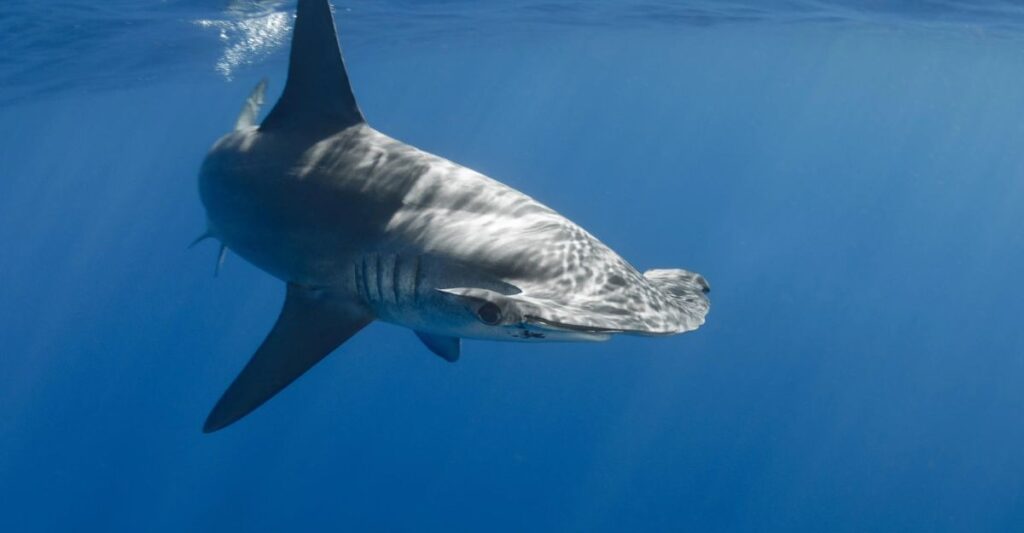
The smooth hammerhead is very similar to its scalloped cousin but with one key difference: its hammer-shaped head does not have the central notch or scalloped edge. Instead, the front is smoothly curved.
Smooth hammerheads grow up to 13 feet long. Their back is grayish-brown and their underside is lighter. They are found in deeper reef zones, continental shelves, and offshore areas around all of Hawaii’s main islands.
These sharks are generally less commonly seen than scalloped hammerheads. They prefer deeper water. Divers and fishers are more likely to encounter them than casual swimmers.
Smooth hammerheads feed on anchovies, sardines, squid, crustaceans, and smaller sharks. Like their relatives, they can behave aggressively toward fishing activities, sometimes stealing catches.
Their population is currently classified as Vulnerable. Shark finning for international markets has caused significant declines. Protecting smooth hammerheads is an important part of overall Hawaiian shark conservation.
Whitetip Reef Shark: The Ocean Floor’s Night Hunter
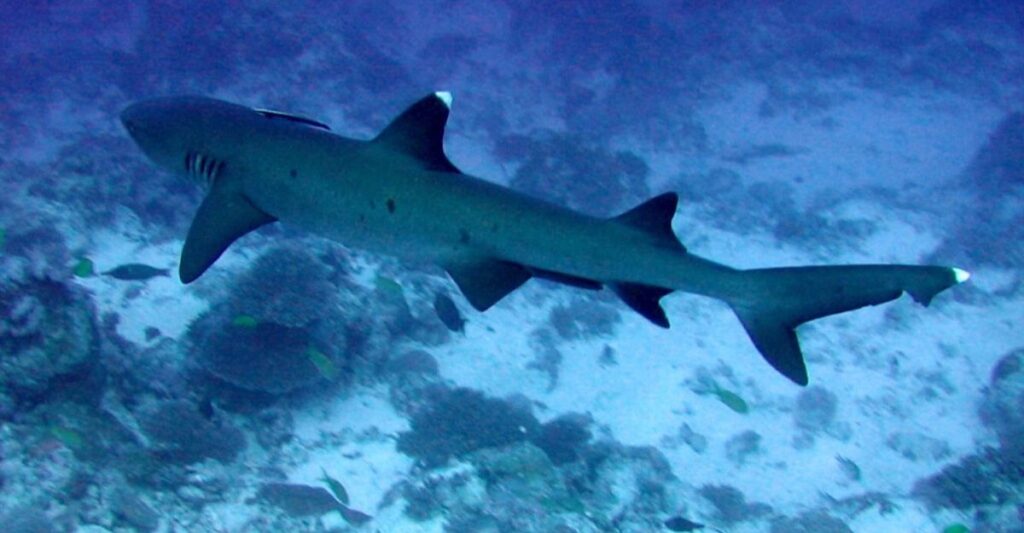
The whitetip reef shark is one of the most unique types of sharks in Hawaii. Its Hawaiian name is manō lalakea. Unlike most sharks, which must keep swimming to breathe, the whitetip reef shark can rest motionless on the ocean floor.
Whitetip reef sharks are small. They typically stay under 5 feet long. Their bodies are gray to brownish-gray with white tips on their dorsal and tail fins. They have a broad, flat head and large eyes suited to low-light hunting.
These sharks are nocturnal hunters. They spend the day resting in reef caves and crevices. At night, they come alive and actively pursue prey through coral channels, sometimes in groups.
They feed on fish, octopus, crustaceans, and cephalopods. Their flat head and slim body allow them to squeeze into tight reef spaces to flush out prey.
Whitetip reef sharks are completely harmless to humans. They are curious animals but show no aggression. Divers often find them resting on the seafloor and can observe them closely without any concern.
Their populations face threats from illegal fishing activities, habitat loss, and accidental entanglement in fishing nets. Scientists believe their numbers have declined significantly in recent decades.
Other Notable Types of Sharks in Hawaii
Beyond the eight most common types of sharks in Hawaii, several other species also appear in Hawaiian waters.
The bignose shark is a deepwater species named for its large, prominent snout. It typically grows to 8 to 9 feet long and is found at depths from 90 to 1,200 feet around all the main Hawaiian islands. It is protected under Hawaii state law since 2010.
The blacktip shark is similar to the blacktip reef shark but is a different species. It grows up to 8 feet long and prefers coastal reef areas, bays, and estuaries. It feeds cooperatively in groups, following schools of tuna and mackerel.
Whale sharks occasionally visit Hawaiian waters, though sightings are rare. These gentle giants are the largest fish on Earth. They can grow over 40 feet long. Despite their size, they are harmless filter feeders.
Mako sharks and thresher sharks appear in deeper offshore waters. Cookie-cutter sharks, famous for biting neat plugs of flesh from larger marine animals, also inhabit Hawaiian deep waters.
Shark Safety Tips for Swimmers and Divers in Hawaii
Knowing the types of sharks in Hawaii is the first step to staying safe. Here are practical tips every ocean user should follow.
Avoid entering the water at dawn, dusk, or at night. Most sharks are most active during these low-light hours. Stay out of murky water where visibility is limited. Sharks may be unable to distinguish you from their natural prey.
Do not swim near river mouths after heavy rain. Floodwater carries organic matter that attracts sharks. Avoid areas where people are actively fishing. Bait and fish blood attract sharks quickly.
Do not wear shiny jewelry or bright contrasting colors. These can catch a shark’s eye and trigger curiosity.
If you encounter a shark, stay calm. Do not thrash or splash. Maintain eye contact and back away slowly without turning your back. If the shark approaches, use any object to gently push it away.
Most types of sharks in Hawaii have never caused a serious incident with humans. Their natural instinct is not to attack. Accidents happen when sharks are surprised, provoked, or confuse a human’s silhouette for a sea turtle or seal.
The Role of Sharks in Hawaiian Culture
In Native Hawaiian culture, sharks are not feared. They are revered.
Many Hawaiian families consider sharks their ‘aumakua, which means ancestral guardian spirit. These family guardians are believed to protect fishermen at sea and guide lost swimmers safely back to shore.
The shark spirit is treated with respect and never harmed by those who carry it as their ‘aumakua. This deep cultural relationship with sharks has shaped how Hawaii views these animals, not as threats but as sacred ocean protectors.
This cultural perspective aligns beautifully with modern conservation. When communities see sharks as sacred and valuable, they are more motivated to protect them.
Hawaii became the first U.S. state to ban shark finning in 2010. This landmark conservation victory reflects both modern science and traditional Hawaiian values working together.
Why Shark Conservation Matters in Hawaii
The types of sharks in Hawaii face real and serious threats. Overfishing, bycatch, habitat destruction, climate change, and pollution all affect shark populations across the Pacific.
The scalloped hammerhead is critically endangered. The sandbar shark is vulnerable. Several species are near threatened. These are not just labels. They reflect real declines in populations that took millions of years to evolve.
When sharks disappear, entire reef systems suffer. Without apex predators, prey fish overpopulate. Overpopulation depletes algae and smaller organisms that reefs depend on. The reef weakens and eventually collapses.
Protecting the types of sharks in Hawaii means protecting the reefs, the fisheries, the tourism industry, and the cultural heritage of the Hawaiian people.
Simple actions make a difference. Support sustainable seafood choices. Never buy shark fin products. Report illegal fishing. Participate in citizen science programs that monitor shark populations.
Conclusion
The types of sharks in Hawaii are some of the most fascinating animals on the planet. From the powerful tiger shark to the gentle whitetip reef shark sleeping on the ocean floor, each species tells a story about adaptation, survival, and the delicate balance of ocean life.
Hawaii’s waters offer an extraordinary window into the world of sharks. Understanding these animals replaces fear with respect. And respect is exactly what these ancient, magnificent predators deserve.
The next time you enter the ocean in Hawaii, remember that you are stepping into their home. Go gently, go wisely, and take a moment to appreciate the incredible wildlife sharing the water with you.
Frequently Asked Questions
How many types of sharks in Hawaii are there?
Scientists have recorded more than forty shark species in Hawaiian waters, although only a small number are commonly seen near the islands.
Which is the most dangerous among the types of sharks in Hawaii?
The tiger shark is involved in most reported shark incidents in Hawaii. Even so, attacks remain very rare.
Can you safely swim in Hawaii?
Yes. Millions of people swim in Hawaii every year without problems. Following local safety advice greatly reduces any risk.
What is the largest type of shark in Hawaii?
The whale shark is the largest shark found in Hawaiian waters. It is also the largest fish in the world and is harmless to humans.
Which sharks are commonly seen while snorkeling?
Blacktip reef sharks and whitetip reef sharks are the species most often seen around shallow coral reefs by snorkelers and divers.
