

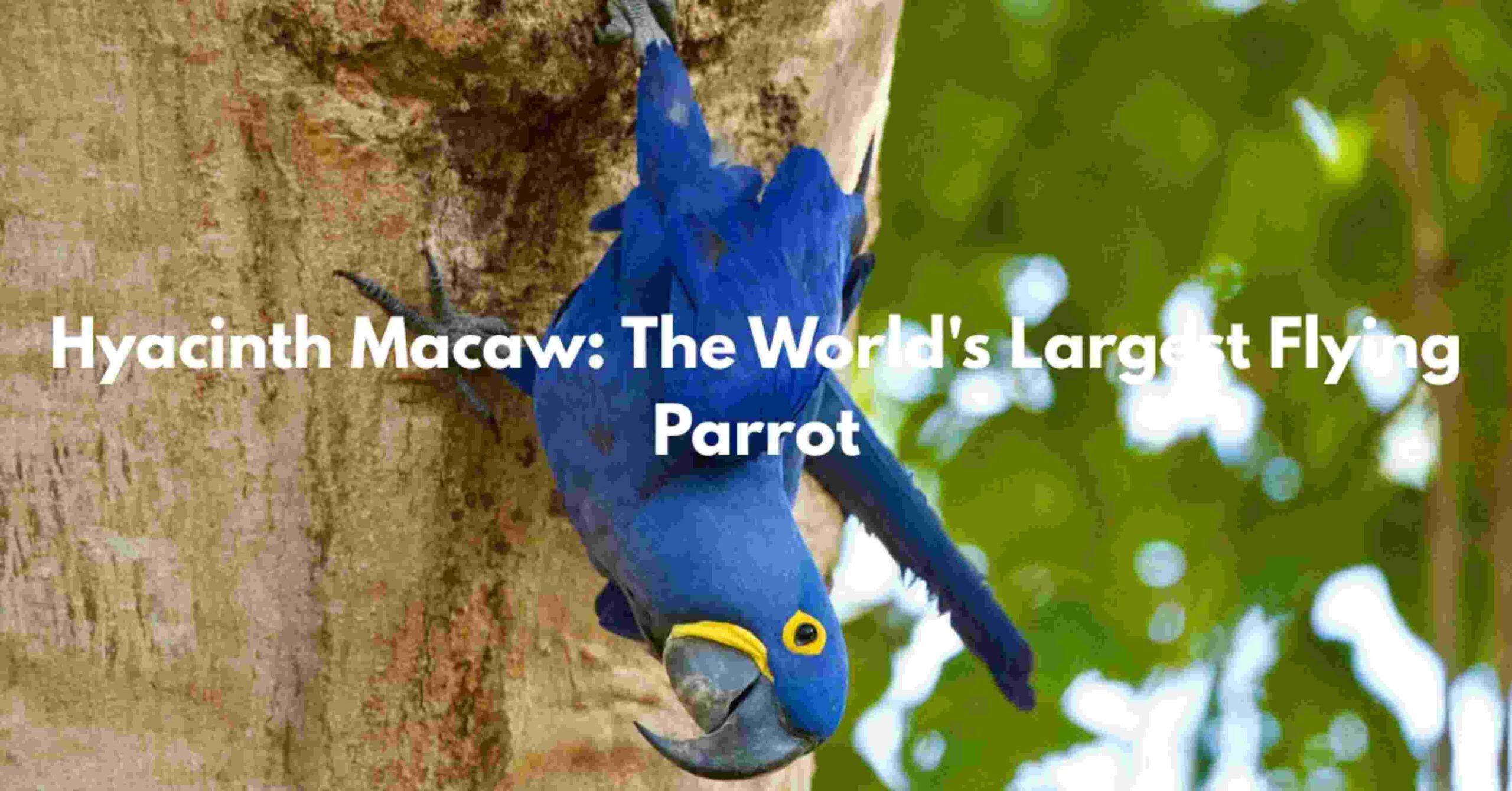
Picture a bird the size of a house cat, covered in feathers the color of a clear summer sky, with a beak strong enough to crack a coconut like it is a peanut. That bird is real, and it is called the hyacinth macaw. It is not just another pretty parrot. It is the biggest flying parrot on the planet, and its story is full of surprises.
This gentle giant glides over wetlands in South America. It forms lifelong friendships with its mate. It even depends on cows to help it eat dinner. Stick around, because the life of the hyacinth macaw is stranger and more fascinating than you might expect.
In this article, we will explore where this bird lives, what makes it so special, what it eats, how it raises its young, and why its future still hangs in the balance. Whether you are a lifelong bird lover or just curious, you will walk away knowing this magnificent parrot much better.
What Is a Hyacinth Macaw?
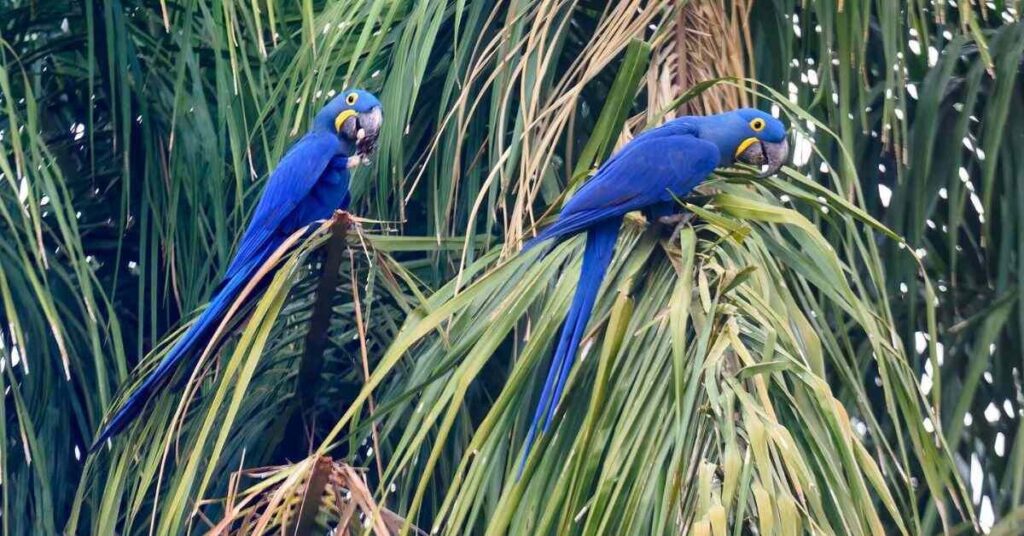
The hyacinth macaw carries the scientific name Anodorhynchus hyacinthinus. Its name comes from the hyacinth flower, which shares that same deep blue shade. This bird is often called the blue macaw because of its rich cobalt color.
This parrot is the largest flying parrot species in the world. A flightless parrot called the kakapo weighs more, but it cannot get off the ground. The hyacinth macaw can fly, glide, and soar with ease, which makes its size even more impressive.
Adult birds usually weigh between two and a half and almost four pounds. From beak to tail tip, they can stretch up to forty inches long. Their wingspan often passes four feet. That is roughly the height of a seven year old child measured across the wings alone.
The hyacinth macaw belongs to a small genus that includes only two other birds. One is the Lear’s macaw, a smaller blue cousin. The other is the glaucous macaw, which has not been seen since the 1980s and is likely extinct. This makes the hyacinth macaw one of the last giants of its kind still flying free.
| Quick Fact | Detail |
| Scientific name | Anodorhynchus hyacinthinus |
| Length | Up to 40 inches |
| Weight | 2.5 to 3.75 pounds |
| Wingspan | 46 to 50 inches |
| Lifespan in wild | Up to 60 years |
| Conservation status | Vulnerable |
Where Does the Hyacinth Macaw Live?
The hyacinth macaw calls South America home. You will find it mainly in Brazil, with smaller numbers reaching into Bolivia and Paraguay. This bird favors open and lightly forested land rather than deep, thick jungle.
Its most important home is the Pantanal, the largest wetland on earth. More than seventy five percent of all wild hyacinth macaws live in this single region. The Pantanal offers exactly what this bird needs. It has tall trees for nesting and palm groves loaded with food.
Beyond the Pantanal, the hyacinth macaw also lives in the Cerrado savanna in eastern Brazil. Small populations spread through states like Maranhão, Bahia, and Mato Grosso. A separate group survives in open patches of the eastern Amazon basin, near rivers such as the Tocantins and Xingu.
This bird prefers palm swamps, flooded grasslands, and scattered woodland over dense forest canopy. It needs wide open sky to fly and land safely, since its long tail and broad wings work best with room to maneuver. It also needs specific old trees for nesting, which limits where it can settle down.
Because its habitat needs are so particular, protecting a few key regions like the Pantanal does an enormous amount of good for the entire species.
What Makes the Hyacinth Macaw Look So Special?
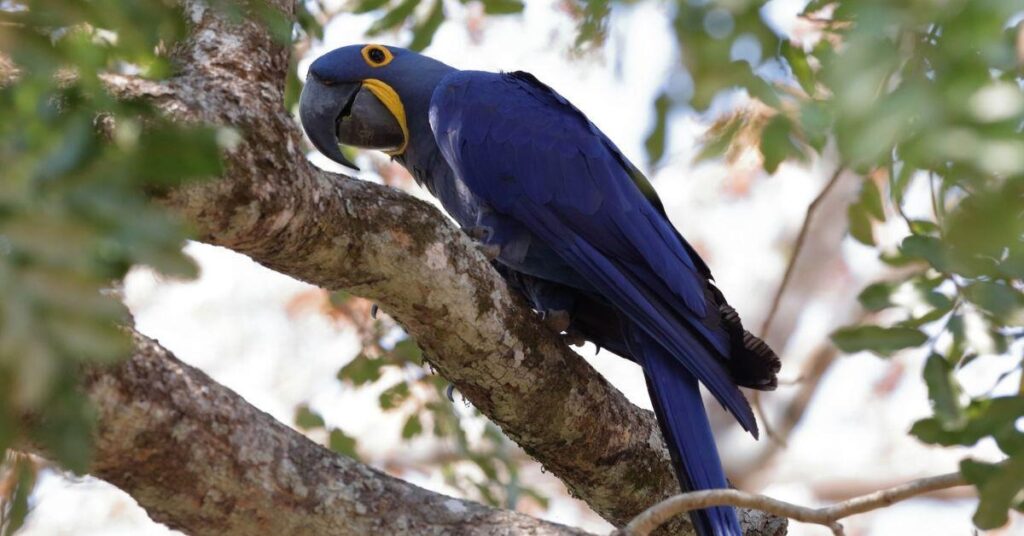
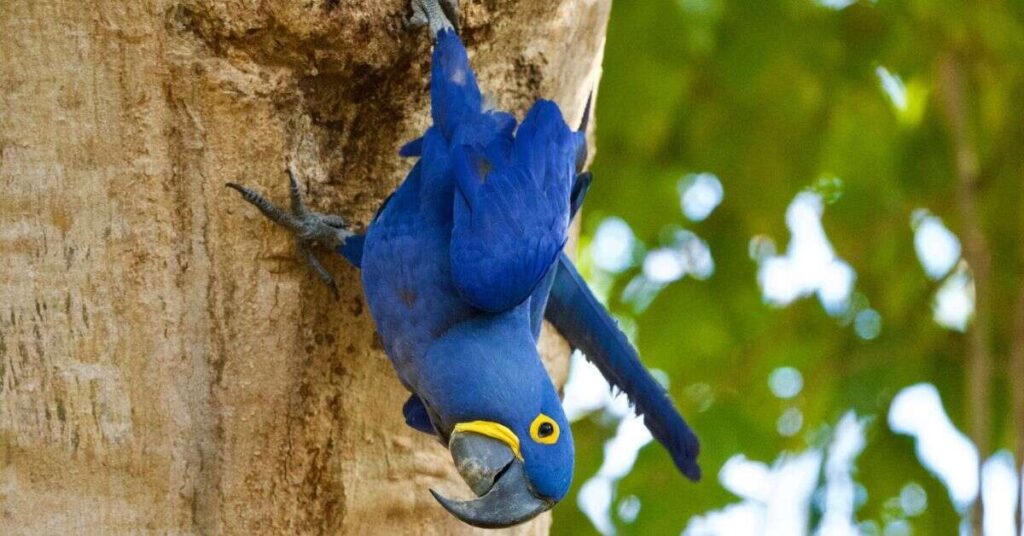
Nothing else in the bird world looks quite like the hyacinth macaw. Its body is covered in deep, glossy cobalt blue feathers from head to tail. The underside of its wings and tail carries a darker gray blue shade that flashes when the bird takes flight.
Bright yellow rings circle its dark eyes like a pair of glasses. Another patch of yellow sits at the base of its lower beak. These yellow markings stand out sharply against the blue and give the bird an almost cheerful, smiling expression.
The beak itself is enormous, curved, and jet black. It is built like a powerful tool rather than a delicate instrument. Even the tongue is unusual. It is black, dry, and slightly scaly, with a streak of yellow running along its side. A small bone inside the tongue gives it extra flexibility, which helps the bird handle food and mimic sounds.
Like all parrots, the hyacinth macaw has zygodactyl feet. This means two toes point forward and two point backward. This grip works almost like a human hand, letting the bird hold food, climb branches, and manipulate objects with real precision.
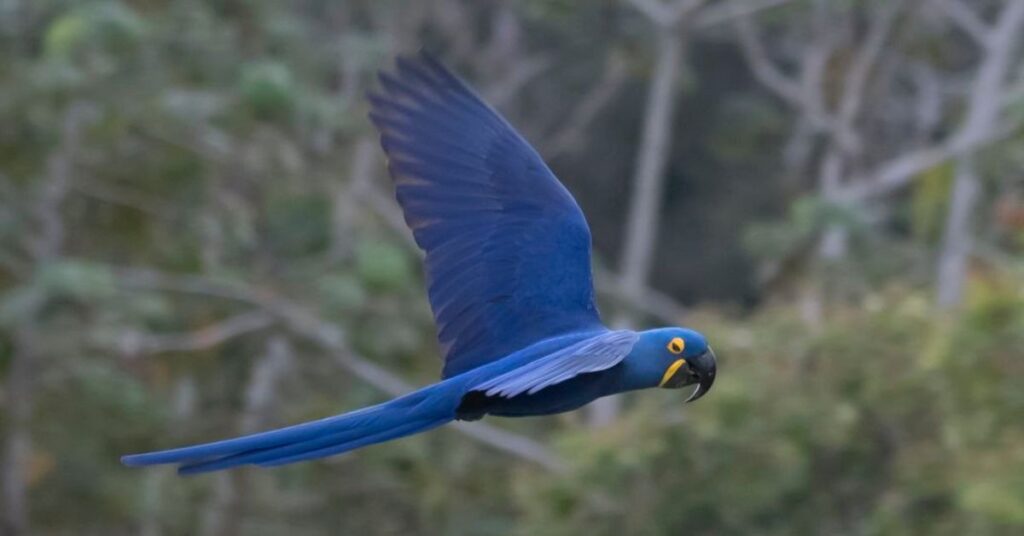
In flight, this bird is graceful despite its size. Its long, tapered tail and wide wings let it glide smoothly, reaching speeds close to thirty five miles per hour without constant flapping.
What Does the Hyacinth Macaw Eat?
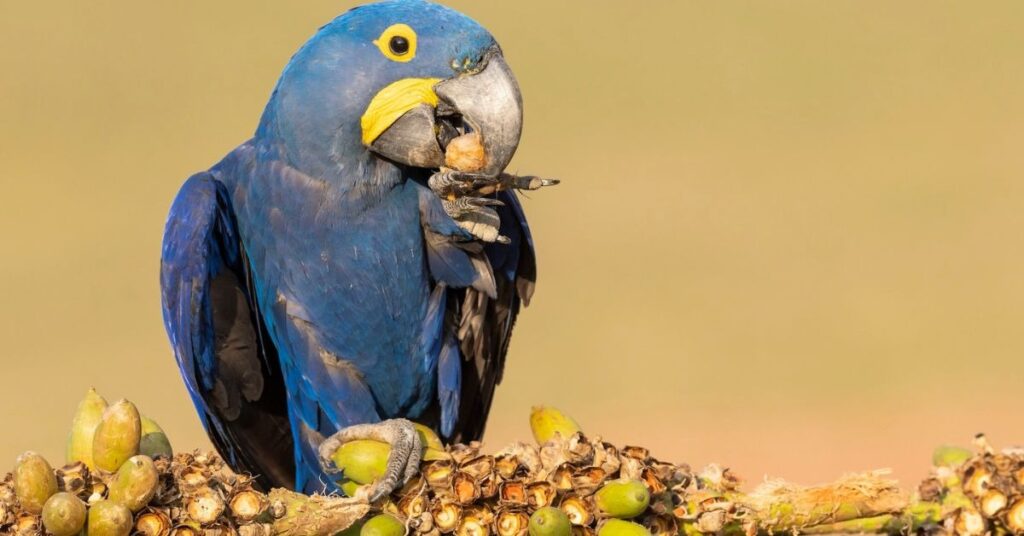
Diet defines much of the hyacinth macaw lifestyle. In the wild, this bird eats mostly palm nuts, especially from acuri and bocaiuva palms found across the Pantanal. These nuts have shells so tough that a human would need a hammer to crack them open.
The hyacinth macaw does not need any tools. Its beak can generate roughly three hundred pounds of pressure per square inch. That kind of force snaps through thick, woody shells with ease, giving the bird access to the soft, fatty kernel inside.
Beyond palm nuts, this parrot also eats Brazil nuts, walnuts, and other rich, oily seeds. It supplements its diet with fruit, vegetables, and occasionally small invertebrates like insects and snails.
Here is where things get strange and wonderful. Some palm seeds have such a hard outer coating that even the hyacinth macaw struggles at first. Cattle in the region eat the same palm fruit, but their digestive systems cannot break down the tough seed. The cows pass the seeds whole in their dung. The hyacinth macaw then forages through cattle droppings, picking out these softened seeds and cracking them open with ease. This odd partnership between a giant parrot and grazing cattle shows just how adaptable nature can be.
These birds are also messy eaters. They often carry food a distance before eating, dropping bits along the way. This habit accidentally helps spread palm seeds across the landscape, supporting the very trees the birds depend on.
How Do Hyacinth Macaws Behave and Communicate?
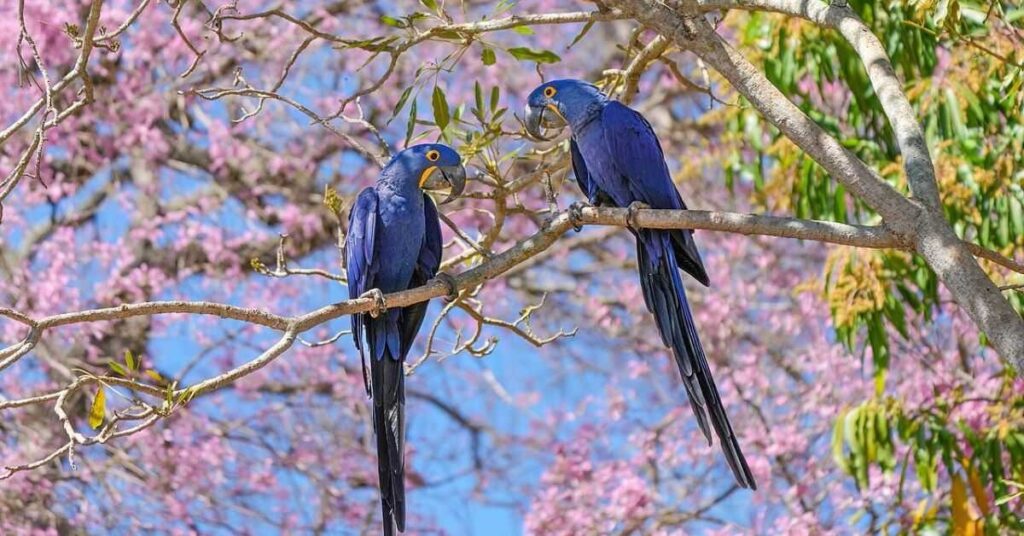
Social life sits at the center of hyacinth macaw behavior. These birds form monogamous pairs and typically mate for life. Partners stay close together nearly all the time, only separating briefly when one leaves to search for food.
Grooming plays a huge role in their daily routine. Pairs spend long stretches of the day preening each other, cleaning feathers, and tidying their beaks. This bonding behavior peaks around dawn and dusk, though it can happen anytime.
Outside of breeding season, hyacinth macaws often gather in small flocks, sometimes reaching up to eight pairs. Even within a group, mated pairs stick close together, flying and perching side by side.
Communication among these birds is loud and impossible to miss. Their calls include harsh, far reaching squawks used to keep in touch over long distances. Softer contact notes pass between partners during quiet moments of foraging or resting. When alarmed, their calls turn sharp and rapid, often paired with an immediate dash into the sky.
These birds are not usually aggressive toward people, but they will defend their nests and feeding grounds fiercely. A defensive hyacinth macaw may swoop at an intruder, puff up, and let out a piercing warning call. Given their bite strength, this is a warning worth taking seriously.
How Do Hyacinth Macaws Raise Their Young?
Breeding comes late for the hyacinth macaw. Birds usually do not reach reproductive maturity until around seven years of age. Once ready, they seek out a lifelong partner and begin the slow, careful process of raising a family.
Nesting sites matter enormously to this species. Pairs build nests in mature trees, often sixty years old or more, with the Manduvi tree serving as the top choice in the Pantanal. Nests sit high above the ground, usually twenty to thirty feet up, tucked inside natural tree cavities.
A female typically lays two to three eggs, though in most cases, only one chick survives to fledge. Incubation lasts about twenty seven to thirty days, during which the female rarely leaves the nest. The male takes on the job of hunting for food, feeding his mate, and standing guard against threats.
Once hatched, chicks grow slowly. It takes roughly one hundred five to one hundred ten days before a young macaw is ready to fledge and leave the nest. Even after that milestone, the young bird sticks close to its parents for another nine months to a year, relying on them for food and guidance as it learns to survive independently.
This slow, careful approach to raising young is part of why hyacinth macaw populations recover so slowly after any decline.
Table: Hyacinth Macaw Breeding Timeline
| Stage | Approximate Duration |
| Age at breeding maturity | About 7 years |
| Eggs laid per clutch | 2 to 3 |
| Incubation period | 27 to 30 days |
| Time to fledge | 105 to 110 days |
| Time near parents after fledging | 9 months to 1 year |
Is the Hyacinth Macaw Endangered?
Conservation status is a serious topic for the hyacinth macaw. This species is currently listed as vulnerable on the IUCN Red List. Recent surveys estimate the wild population somewhere between 4,700 and 11,000 mature individuals, with the majority living in the Pantanal.
The biggest historical threat came from illegal trapping for the pet trade. During the 1980s alone, more than ten thousand birds were captured and removed from the wild. This wave of trapping pushed the species toward serious decline before international protection stepped in.
In 1987, the hyacinth macaw was added to CITES Appendix I, a global agreement that bans commercial trade of endangered wildlife across borders. This protection dramatically slowed illegal capture, though poaching has not disappeared completely.
Habitat loss remains an ongoing concern. Cattle ranching, deforestation, and wildfires all damage the palm groves and old growth trees this bird depends on for food and nesting. Because hyacinth macaws need specific mature trees for nesting, losing even a modest number of these old trees can limit where pairs can successfully raise chicks.
The encouraging news is that dedicated conservation work is paying off. Programs across the Pantanal focus on educating local ranchers, protecting Manduvi trees, and installing artificial nest boxes where natural cavities are scarce. Thanks to these combined efforts, hyacinth macaw numbers in the Pantanal are gradually increasing, offering real hope for this species going forward.
Table: Main Threats and Current Conservation Actions
| Threat | Conservation Response |
| Illegal pet trade | CITES Appendix I protection |
| Habitat loss from ranching | Landowner education programs |
| Deforestation and fires | Habitat and tree protection efforts |
| Shortage of nest cavities | Artificial nest box programs |
Why the Hyacinth Macaw Matters to Its Ecosystem
The hyacinth macaw plays a genuine role in keeping its habitat healthy. As a seed predator, it helps control palm populations by feeding heavily on their nuts. At the same time, its messy eating habits scatter seeds across the landscape, giving some plants a chance to grow in new spots.
This bird also has natural enemies, even though it faces no predators as a full grown adult. Eggs and chicks are vulnerable to animals like coatis, opossums, and corvids. The Toco Toucan stands out as the primary nest predator, raiding eggs and young chicks whenever possible.
Interestingly, the relationship between hyacinth macaws and toco toucans is more complicated than simple rivalry. Toucans also help spread the seeds of the Manduvi tree, the very species that hyacinth macaws depend on for nesting. This means the toucan both threatens and supports the macaw at the same time, a reminder that nature rarely fits into simple categories of friend or foe.
Because the hyacinth macaw sits at the center of so many ecological relationships, protecting this single species helps preserve the wider Pantanal ecosystem as a whole.
Practical Takeaways for Wildlife Lovers
If you care about the hyacinth macaw and want to help, there are meaningful steps you can take. Supporting accredited conservation organizations working in the Pantanal and Cerrado regions makes a real difference on the ground. These groups fund nest box programs, tree protection, and community education.
Choosing responsible ecotourism also helps. Visiting the Pantanal through operators who follow ethical wildlife viewing guidelines supports local economies without disturbing nesting birds. This kind of tourism gives local communities a financial reason to protect macaw habitat rather than clear it.
Avoiding the exotic pet trade matters too. Never purchase a wild caught parrot, and always question the origin of any captive bred bird before considering ownership. Demand drives the market, and reducing that demand protects wild populations.
Spreading accurate information also counts as meaningful action. Sharing real facts about the hyacinth macaw, rather than myths or exaggerated claims, helps build genuine public support for conservation funding and policy.
Conclusion
The hyacinth macaw stands as one of nature’s most remarkable birds. Its size alone would make it memorable, but its brilliant blue feathers, powerful beak, and surprising partnership with grazing cattle make it truly unforgettable. This bird’s slow, patient approach to life, from its long courtship to its careful parenting, reflects an animal built for a long and steady existence.
Yet this giant parrot remains vulnerable. Past trapping and ongoing habitat pressure continue to test its resilience. The encouraging rise in Pantanal populations shows that focused conservation work truly pays off when people commit to protecting critical habitat and stopping illegal trade.
Every one of us can play a small part in securing this bird’s future, whether through responsible travel choices, supporting real conservation groups, or simply learning and sharing its story. The hyacinth macaw has survived for millions of years in the wild. With continued care and attention, there is every reason to believe it can thrive for many more.
Frequently Asked Questions
What is the hyacinth macaw known for?
The hyacinth macaw is known as the largest flying parrot in the world, famous for its brilliant cobalt blue feathers and extremely powerful beak.
How strong is a hyacinth macaw’s bite?
Its bite force reaches roughly three hundred pounds per square inch, strong enough to crack open the toughest palm nuts and seeds.
Where do hyacinth macaws live in the wild?
They live mainly in Brazil, with smaller populations in Bolivia and Paraguay, favoring wetlands like the Pantanal along with savanna and open woodland.
Why is the hyacinth macaw considered vulnerable?
Illegal trapping in past decades combined with ongoing habitat loss from ranching and deforestation has kept the species at risk despite legal protection.
How long do hyacinth macaws live?
In the wild, hyacinth macaws can live up to sixty years, and captive birds sometimes live even longer under proper care.
