

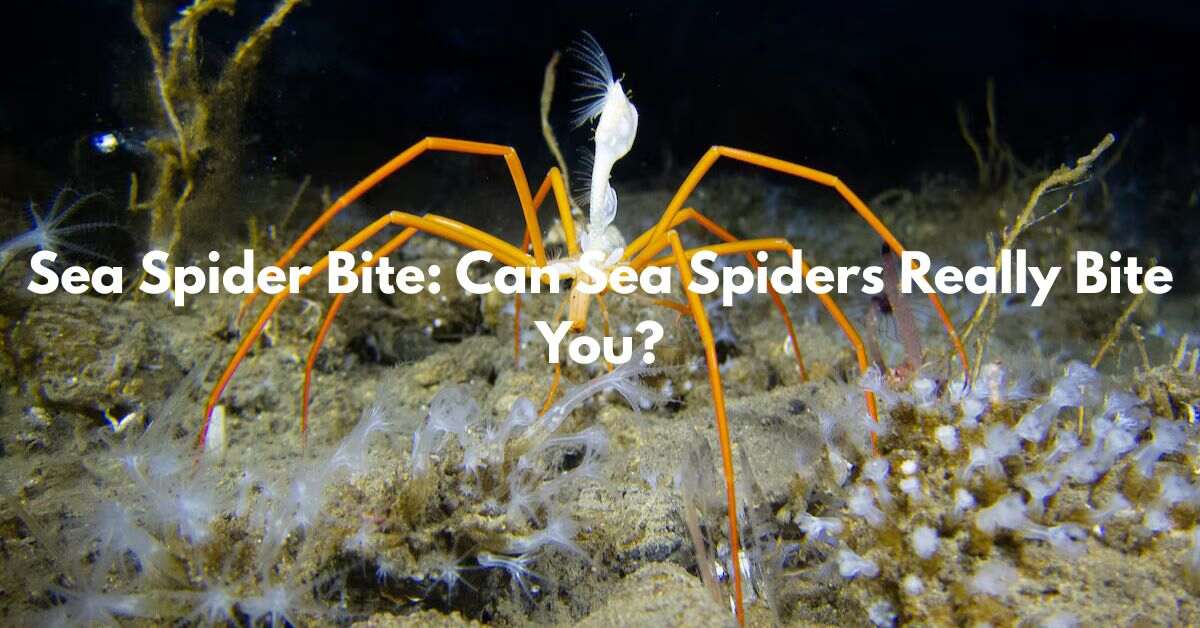
You are wading through a rock pool. You spot a strange creature with long, spindly legs and a tiny body. It looks like a spider, but it is underwater. Your first question is probably: can this thing bite me?
This is a question many beach-goers, divers, and ocean lovers ask about sea spiders. These alien-looking creatures seem scary at first glance. But the truth about a sea spider bite might surprise you.
In this article, we explore everything you need to know about sea spiders. We cover what they are, how they feed, whether a sea spider bite is a real threat, and what you should do if you ever come across one.
What Exactly Is a Sea Spider?
Before we talk about the sea spider bite, let us first understand what a sea spider actually is.
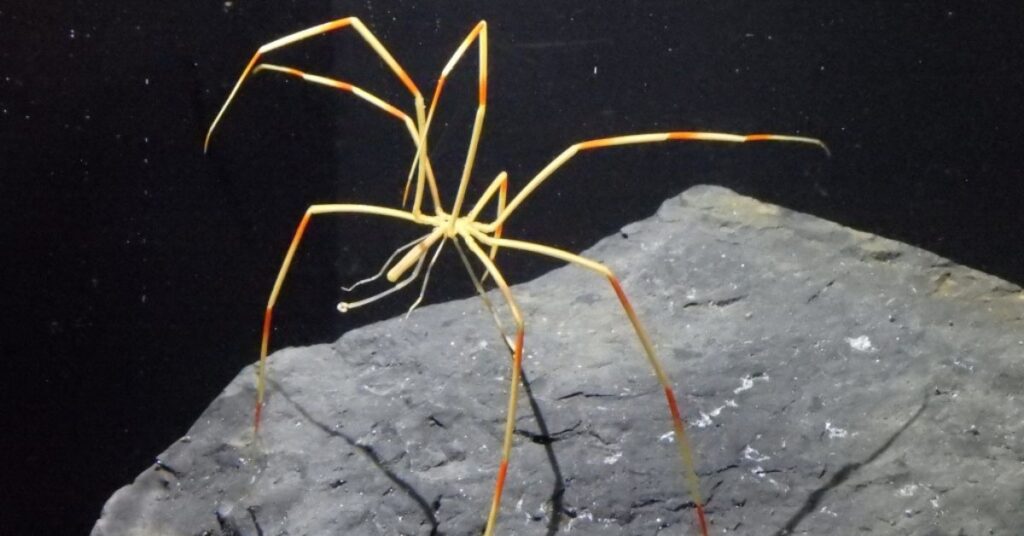
Sea spiders are marine arthropods. They belong to a class called Pycnogonida. Despite their name and their eight spindly legs, sea spiders are not true spiders. They are not even arachnids. They belong to a completely separate branch of the animal kingdom.
Scientists believe sea spiders split off from other arthropods hundreds of millions of years ago. They are one of the oldest surviving groups of marine creatures on the planet. Over 1,300 known species of sea spiders exist across the world’s oceans.
Their bodies are incredibly small. Most of their mass is actually made up of their long, thin legs. The body is so tiny that many of their internal organs, including parts of the digestive system and reproductive organs, are stored inside the legs themselves.
Sea spiders do not have a respiratory system. Their bodies are so thin that gas exchange simply happens through the body surface. They breathe through their skin.
The name Pycnogonida comes from the Greek words meaning “thick” or “knobby,” which refers to their many leg joints. Their other class name, Pantopoda, translates to “all feet,” which perfectly describes how they look.
Where Do Sea Spiders Live?
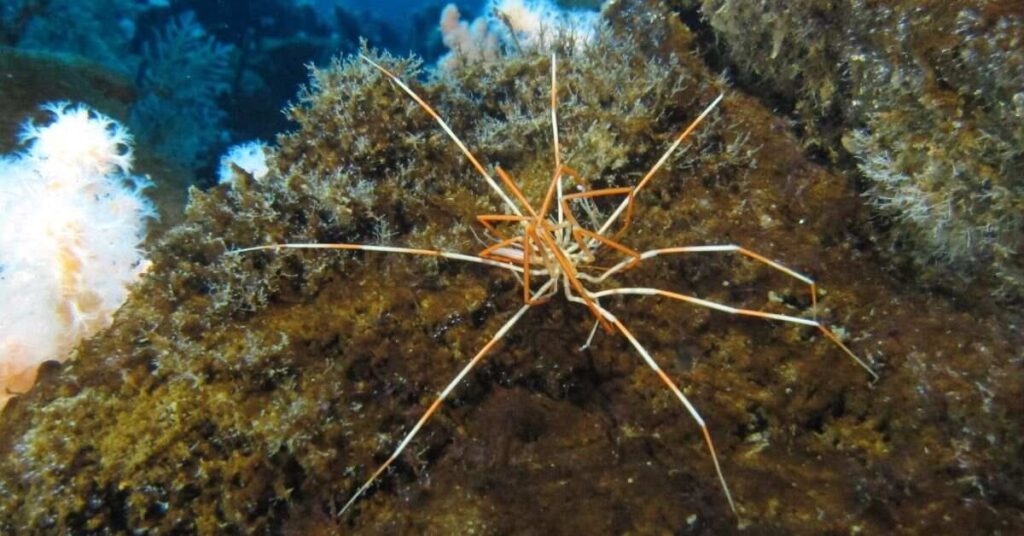
Sea spiders live in every ocean on Earth. You can find them from tropical shallow waters all the way to the freezing depths of the Antarctic Ocean. They have been discovered at depths of over 23,000 feet below the ocean surface.
They are commonly found in:
| Habitat | Description |
| Rock pools | Shallow coastal waters and tide pools near the shore |
| Coral reefs | Among corals and sponges in warm tropical waters |
| Deep ocean floors | Found at extreme depths, including hydrothermal vents |
| Antarctic waters | Giant species thrive in the cold, oxygen-rich polar seas |
| Kelp forests | Hiding among seaweed and algae on rocky coastlines |
Most species are very small. Shallow-water sea spiders usually measure around 3 mm to 10 mm in body length. However, deep-sea and Antarctic species can grow much larger. The giant Antarctic sea spider (Colossendeis megalonyx) can have a leg span of up to 70 cm, which is nearly two and a half feet wide.
Sea spiders are found in the Pacific waters around the United States and Japan. They also live in the Caribbean Sea, the Mediterranean Sea, and along the rocky coastlines of the UK.
How Do Sea Spiders Feed? (Hint: It Is Not What You Think)
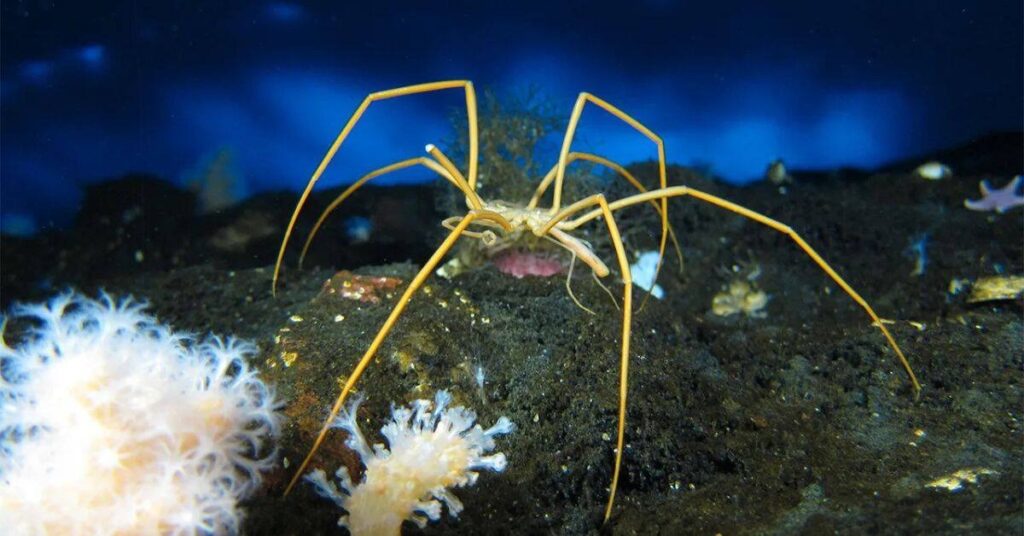
Here is where sea spiders get truly fascinating. They do not bite their food. They suck it up.
Sea spiders use a structure called a proboscis to feed. This is a long, tube-like appendage located at the front of their head. Think of it as a built-in drinking straw. The proboscis ends in a small, triangular mouth.
They feed on soft-bodied creatures such as:
- Sea anemones
- Hydroids
- Sponges
- Bryozoans
- Soft corals
The sea spider pushes its proboscis into the body of its prey. It then slowly sucks out the juices and soft tissue. Interestingly, sea spiders do not always kill their prey. Many times, they nibble just a small section of tissue and move on. The prey survives and regenerates the lost tissue.
This feeding method is more like a gentle sip than an aggressive bite. They do not use fangs. They do not inject venom. The proboscis is designed for suction, not for piercing hard skin or causing harm to larger animals.
This is a key reason why sea spider bites on humans are not a real concern.
Can a Sea Spider Bite Humans?
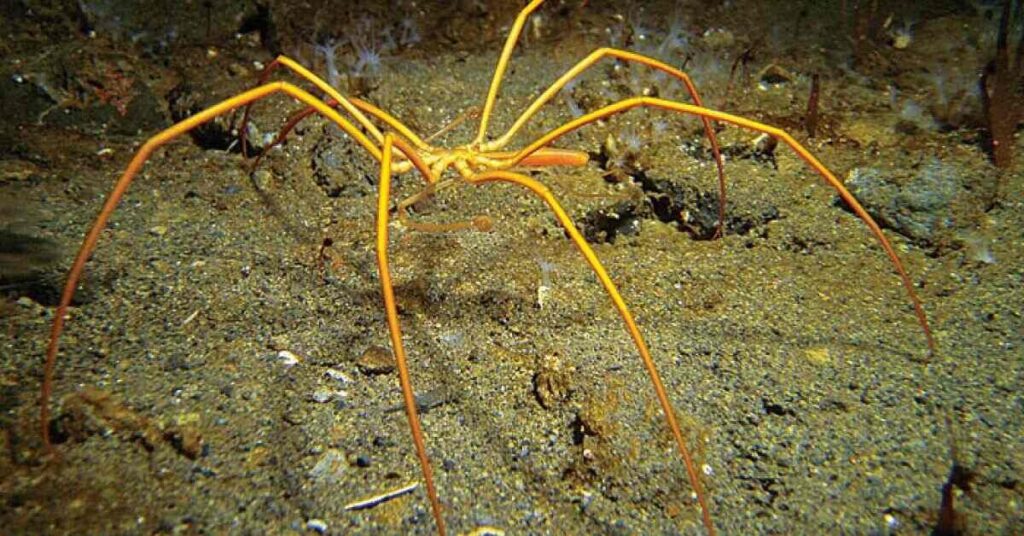
This is the big question. Let us answer it clearly and directly.
No. Sea spiders cannot meaningfully bite humans.
Sea spiders do not have fangs. They do not have venom glands. Their proboscis is built specifically for sucking soft-bodied invertebrates. It is not designed to pierce through human skin.
Even if a sea spider attempted to make contact with you, it would not be able to cause a real wound. Their mouthparts are tiny and weak. They pose zero threat to humans.
Scientists and marine biologists confirm this. Sea spiders are entirely harmless to people. You could hold one in your hand and it would simply crawl around on its delicate legs without causing you any harm.
So where does the fear of a sea spider bite come from?
Most of it comes from their appearance. Sea spiders look genuinely unsettling. Their long, jointed legs, alien-like body, and slow, deliberate movements make people nervous. But looks can be very deceiving when it comes to wildlife.
Are Sea Spiders Venomous?
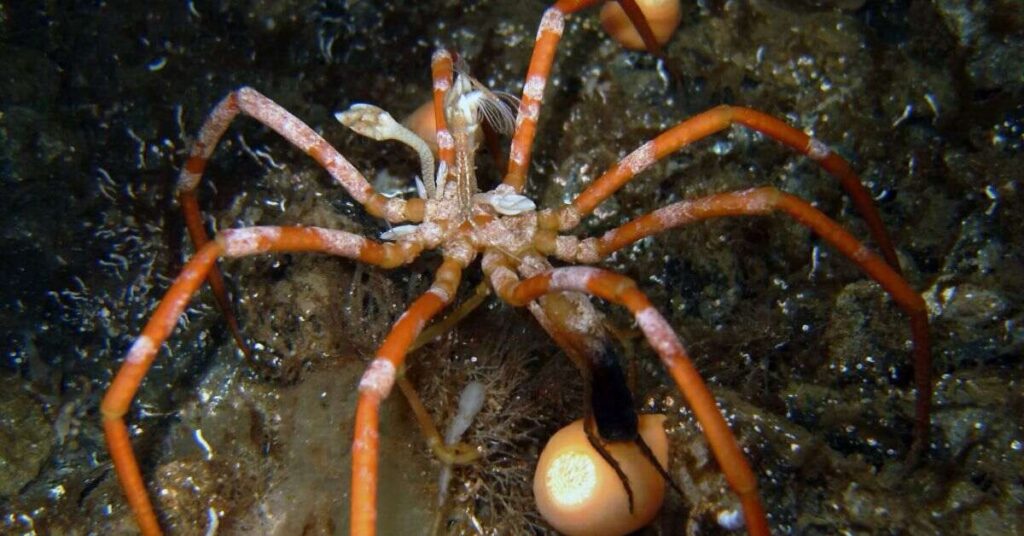
No. Sea spiders are not venomous.
Some ocean creatures use venom to paralyse or kill their prey. Sea spiders do not fall into this category at all. They lack venom glands entirely. They have no mechanism to inject any toxic substance into another animal, including humans.
Some sources mention that certain sea spider species may produce mild secretions, but these are not dangerous to humans in any way. Even if you came into skin contact with a sea spider, there would be no reaction.
Compare this to genuinely venomous ocean creatures like the blue-ringed octopus or stonefish. Those animals carry real danger. Sea spiders are nothing like them.
If you are stung or bitten by something at the beach and you are unsure of the cause, do not automatically assume it was a sea spider. It is far more likely to be a jellyfish sting, a sea urchin spine, or a bite from a different type of marine creature entirely.
Sea Spiders vs. Spiders Found at the Beach
It is also important not to confuse sea spiders with land spiders that happen to live near the ocean. These are very different creatures, and some land spiders found near beaches can bite.
Here is a quick comparison:
| Feature | Sea Spider (Pycnogonida) | Beach Wolf Spider |
| Habitat | Fully aquatic, lives in the ocean | Lives on land near beaches |
| Bite risk | Cannot bite humans | Can bite if threatened |
| Venom | None | Mild venom, not dangerous |
| Size | 3 mm to 70 cm leg span | 7 mm to 15 mm body length |
| Feeding | Proboscis for sucking prey | Fangs for catching insects |
| Danger to humans | None | Very low |
Beach wolf spiders are the spiders you are more likely to encounter in the sand near the shore. They are fast-moving and can look alarming. Their bite may cause mild pain or slight swelling, but it is not medically dangerous for most people.
Dock spiders, also called fishing spiders, live near water and may also be spotted near coastal areas. Again, they rarely bite and are not considered dangerous.
The key point is this: if you see something that looks like a spider near the beach, it is almost certainly a land-based spider and not a true sea spider. True sea spiders live in the water, not on the sand.
Read about it more:https://www.wildlifenomads.com/blog/what-are-sea-spiders-facts/
The Fascinating Anatomy of Sea Spiders
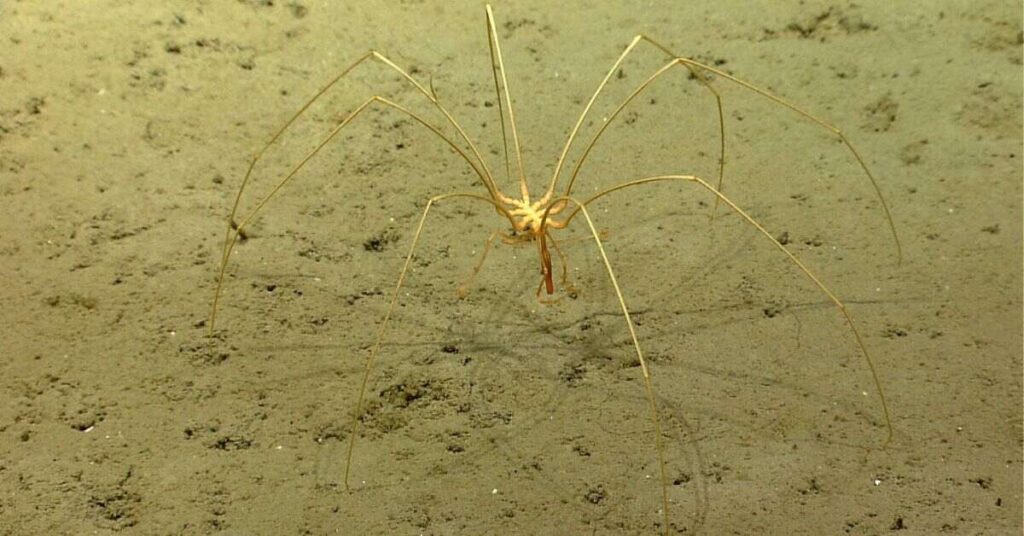
Sea spiders have one of the most unusual body plans in the entire animal kingdom. Understanding their anatomy helps explain why a sea spider bite is simply not possible.
Their body is made up of two main sections: the cephalothorax (head and upper body) and a tiny abdomen. The abdomen is so small it is almost invisible. The cephalothorax carries all the legs, the proboscis, and the sensory organs.
On top of the cephalothorax sits an ocular tubercle, a raised bump that holds four simple eyes. In deep-sea species, these eyes are often absent because light does not reach those depths.
Sea spiders also have three other types of appendages beyond their walking legs:
Chelifores are claw-like pincers near the mouth. They help grip food and hold onto surfaces. They are extremely small.
Palps are sensory appendages that work like antennae. They help the sea spider detect its environment.
Ovigers are unique to sea spiders. These are special leg-like structures used for cleaning and, importantly, for carrying eggs. Male sea spiders use their ovigers to carry fertilised eggs until they hatch. This makes sea spider fathers some of the most dedicated dads in the ocean.
None of these appendages are capable of causing harm to a human.
The Role of Sea Spiders in the Ocean Ecosystem
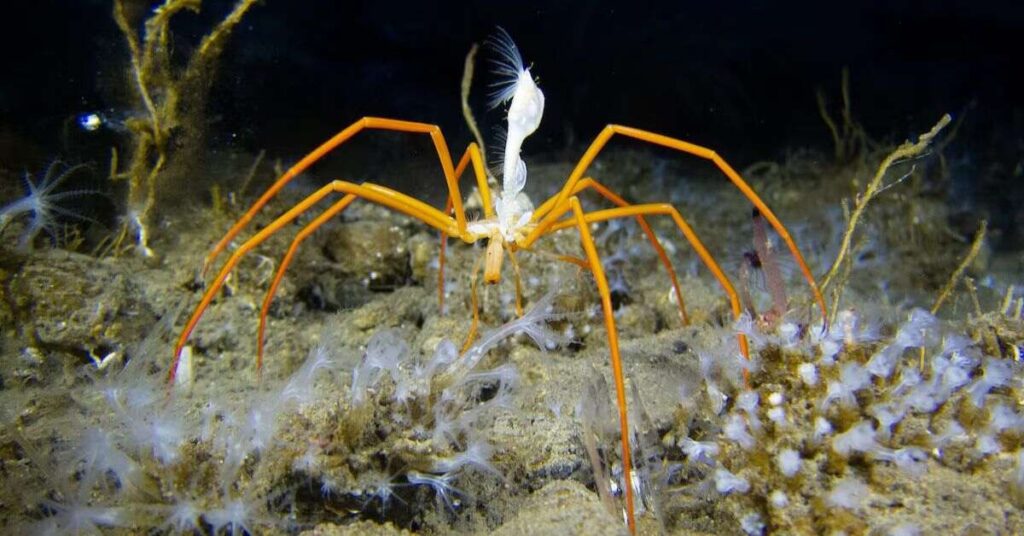
Sea spiders play a quiet but important role in the health of the ocean.
They act as natural grazers on soft-bodied invertebrates. By feeding on sponges, anemones, and hydroids, they help regulate the populations of these animals. This keeps the ocean ecosystem in balance.
In deeper waters, sea spiders are also scavengers. They help break down organic material, contributing to the nutrient cycle on the ocean floor.
In the Antarctic, giant sea spiders are a significant part of the local food web. They feed on large colonies of bryozoans and sponges that thrive in cold, oxygen-rich polar waters.
Scientists also study sea spiders because of their ancient evolutionary history. Understanding how these creatures have survived for hundreds of millions of years tells us a great deal about how life adapts to extreme environments. Sea spiders have been found living near hydrothermal vents, where temperatures and chemical conditions would be deadly to most other creatures.
What to Do If You Spot a Sea Spider
If you are snorkelling, scuba diving, or exploring rock pools, you may come across a sea spider. Here is what you should do:
Stay calm. Sea spiders are completely harmless. There is no need to move away quickly or panic.
Observe from a safe distance. You do not need to touch one. Simply watch it move. Their slow, deliberate crawl on the ocean floor or rock surface is genuinely mesmerising.
Do not disturb their habitat. Lifting rocks or disturbing seaweed in rock pools can damage the delicate ecosystems where sea spiders live. Always replace anything you move.
Take a photo if you can. Sea spiders are fascinating creatures and rarely seen up close. A photograph is a wonderful way to document your encounter.
Do not remove them from their environment. Taking sea spiders from their natural habitat, even briefly, can stress and harm them.
If you are ever unsure whether something in the water has caused a sting or irritation on your skin, seek medical advice promptly. But remember, sea spiders are not the culprit.
Quick Facts About Sea Spiders
Here is a summary of the most important facts about these incredible creatures:
| Fact | Detail |
| Scientific class | Pycnogonida |
| Number of known species | Over 1,300 |
| Leg pairs | Usually 4, some species have 5 or 6 |
| Size range | 1 mm to over 70 cm leg span |
| Diet | Soft-bodied invertebrates, sponges, anemones |
| Feeding method | Proboscis (suction tube), not biting |
| Venom | None |
| Danger to humans | Zero |
| Found in | Every ocean on Earth |
| Depth range | Intertidal zones to 23,000+ feet deep |
| Parental care | Males carry and protect eggs |
Conclusion
The idea of a sea spider bite sounds alarming, but the science is very clear. Sea spiders cannot bite you. They have no fangs, no venom, and no interest in humans whatsoever. Their tiny mouthpart, the proboscis, is built only for sucking soft ocean creatures like sponges and anemones.
These ancient, alien-looking creatures have roamed the oceans for hundreds of millions of years. They are slow, quiet, and completely harmless to people. If anything, they deserve our admiration and protection.
The next time you are exploring the ocean or a rock pool and you spot one of these bizarre, leggy creatures, take a moment to watch it. You are looking at one of the most unusual and fascinating animals on Earth.
Wildlife like sea spiders reminds us how extraordinary and strange life in the ocean can be. And the best thing we can do is leave them undisturbed to continue their ancient role in the deep blue world they call home.
Frequently Asked Questions
Can a sea spider bite humans?
No, a sea spider bite is not considered real. These animals do not have the ability to bite human skin.
Are sea spiders dangerous to swimmers?
Sea spiders are harmless and do not pose any threat to swimmers or divers.
What should I do if I think I got a sea spider bite?
Clean the area with water and observe for any irritation. Most cases are not serious and may be caused by other marine life.
Do sea spiders have venom?
No, sea spiders do not have venom glands and cannot inject toxins into humans.
Where are sea spiders commonly found?
Sea spiders live in oceans worldwide, from shallow coastal waters to deep sea environments.
