

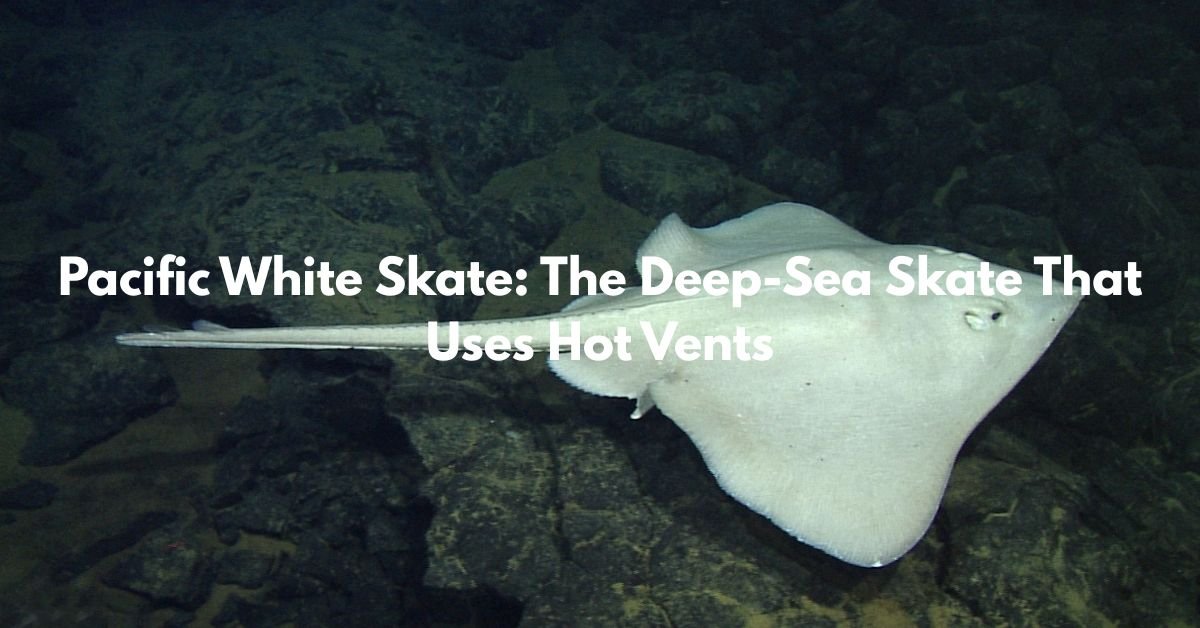
Imagine an animal living nearly two miles below the ocean surface. There is no sunlight, the water is close to freezing, and pressure is enormous. Yet, in this dark world, the Pacific white skate survives and reproduces in a place that seems impossible for life.
The Pacific white skate is a rare deep-sea skate scientifically known as Bathyraja spinosissima. It belongs to the same broad group of cartilaginous fish as sharks and rays. Its pale body and unusual appearance make it easy to recognize, but its breeding behavior makes it even more fascinating.
Scientists made an important discovery in the Galápagos Marine Reserve. They found large numbers of Pacific white skate egg cases around an active hydrothermal vent. These vents release extremely hot water from the ocean floor.
The discovery showed that the Pacific white skate may use the natural warmth around these vents to help its eggs develop. Scientists believe that even a small increase in temperature may shorten the extremely long time needed for the eggs to hatch.
This discovery also shows how much remains unknown about the deep ocean. The Pacific white skate lives in an environment that humans have explored only to a limited extent. Every new observation can reveal something unexpected about how deep-sea animals survive.
What Is the Pacific White Skate?
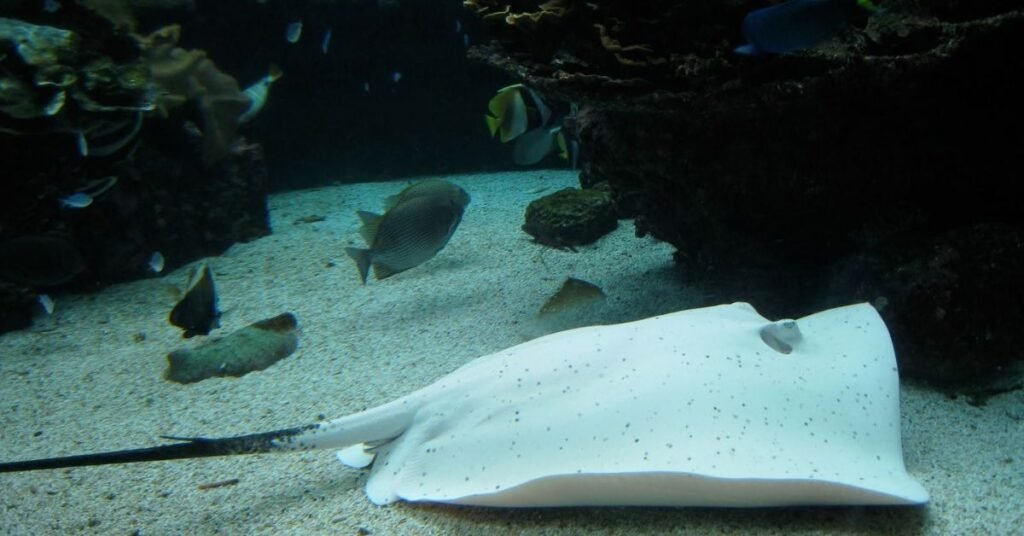
The Pacific white skate is a deep-sea fish that belongs to the skate family. Its scientific name is Bathyraja spinosissima. Like other skates, it has a flattened body, broad fins and a tail. It looks similar to a ray, but skates and rays are different groups of cartilaginous fish.
The Pacific white skate has a pale or whitish body. Its appearance is well suited to the dark environment where it lives. Unlike many familiar coastal fish, it spends much of its life far below the surface.
Scientists have recorded the species at depths approaching 2,900 meters. That is almost 3 kilometers below the ocean surface. At these depths, sunlight cannot reach the seafloor. Water temperatures are also extremely cold in most areas.
The species is one of the deepest-living skates known to science. Its deep-water lifestyle makes direct observation difficult.
Researchers often depend on remotely operated vehicles, also called ROVs, to study animals such as the Pacific white skate. These underwater robots can travel to depths that would be dangerous or impossible for human divers.
The species has also been recorded in areas far beyond the Galápagos. NOAA Fisheries reported Pacific white skate specimens from the Bering Sea and Alaska, showing that its known range extends farther north than researchers previously documented.
Where Does the Pacific White Skate Live?
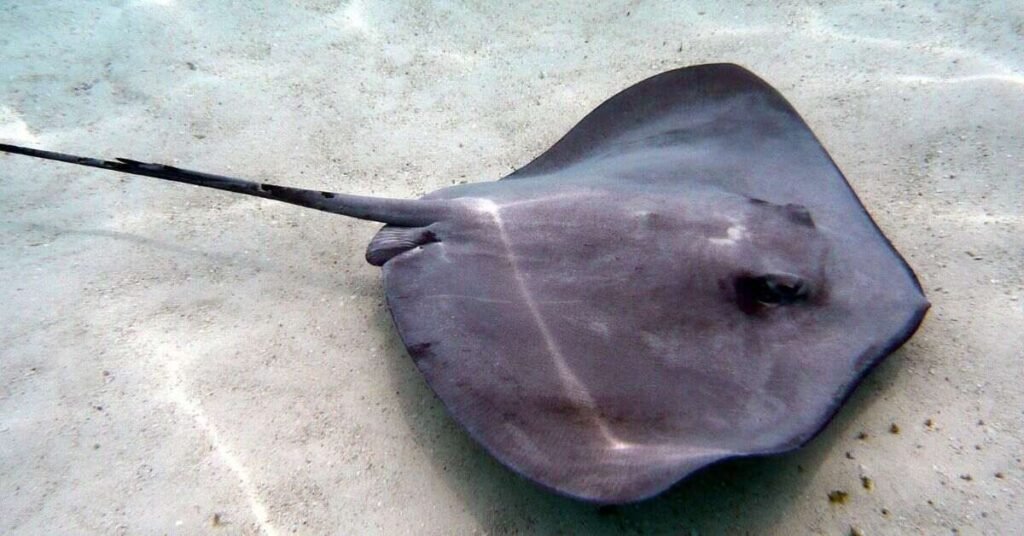
The Pacific white skate lives in the deep Pacific Ocean. It has been recorded from deep waters around parts of the eastern Pacific and farther north into areas such as Alaska.
Its habitat can include deep seafloor areas around slopes, seamounts and volcanic features. A seamount is an underwater mountain that rises from the ocean floor but does not reach the sea surface.
One of the most remarkable locations connected with the species is the Galápagos Rift. This region contains hydrothermal vents created by volcanic activity beneath the ocean.
In 2015, researchers exploring the Galápagos Marine Reserve used an ROV to investigate the deep seafloor. They discovered many Pacific white skate egg cases lying on and around a hydrothermal vent. Researchers collected several egg cases for DNA testing.
The discovery was important because scientists had never before documented a skate using an active hydrothermal vent field as an egg incubation site.
The deep sea normally remains close to freezing. Hydrothermal vents create areas where warmer water enters the surrounding ocean. This creates unusual temperature conditions on the seafloor.
For the Pacific white skate, these small warm areas may provide an important advantage during egg development.
Why Does the Pacific White Skate Lay Eggs Near Hydrothermal Vents?
This is perhaps the most fascinating fact about the Pacific white skate.
Hydrothermal vents are openings in the seafloor. They release water that has been heated underground by volcanic activity. The water coming directly from a vent can reach extremely high temperatures.
The vent water itself can exceed 400°C. However, it quickly mixes with the surrounding deep-sea water, which remains close to freezing. This means that the area around a vent can have warmer zones without the skate eggs being exposed directly to the extreme temperature of the vent fluid.
Scientists believe the Pacific white skate may place its eggs in these warmer areas because temperature affects development.
Deep-sea skate eggs can take a very long time to develop. Researchers estimated that Pacific white skate eggs may require more than four years to hatch, although this estimate was based partly on related species and environmental conditions.
Even a small increase in temperature could potentially speed up development.
This does not mean that the skate places its eggs directly inside boiling water. Instead, the eggs appear to benefit from the warmer conditions around the vent.
This behavior is remarkable because the Pacific white skate appears to use a natural geological feature as part of its reproductive strategy.
Pacific White Skate Eggs and Their Long Incubation
The eggs of the Pacific white skate are very different from the eggs most people see in shallow-water animals.
Female skates produce tough egg cases. These cases protect the developing embryo while it grows. Skate egg cases are sometimes called “mermaid’s purses” because of their shape and appearance.
The Pacific white skate produces relatively large egg cases. During the Galápagos discovery, researchers described the cases as yellow-green and roughly comparable in size to a deflated football.
The long incubation period makes these eggs especially interesting.
In cold deep-sea conditions, development can take years. Researchers estimated that Pacific white skate eggs may take more than four years to hatch. This is an estimate rather than a precisely measured incubation period for every egg.
The use of warmer areas around hydrothermal vents may help reduce this development time.
Scientists still have many questions about the process. They need more observations to understand exactly how often Pacific white skates use vents, how they choose particular sites and how temperature affects embryo development.
The discovery of egg nurseries also highlights why deep-sea habitats deserve careful study. A location that looks like a barren volcanic area may actually be an important nursery for marine life.
What Does the Pacific White Skate Look Like?
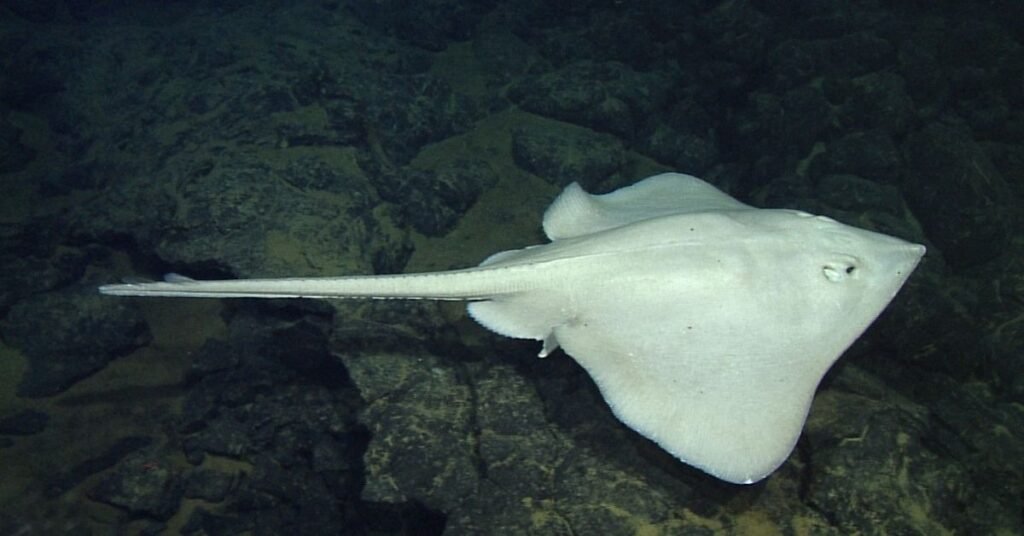
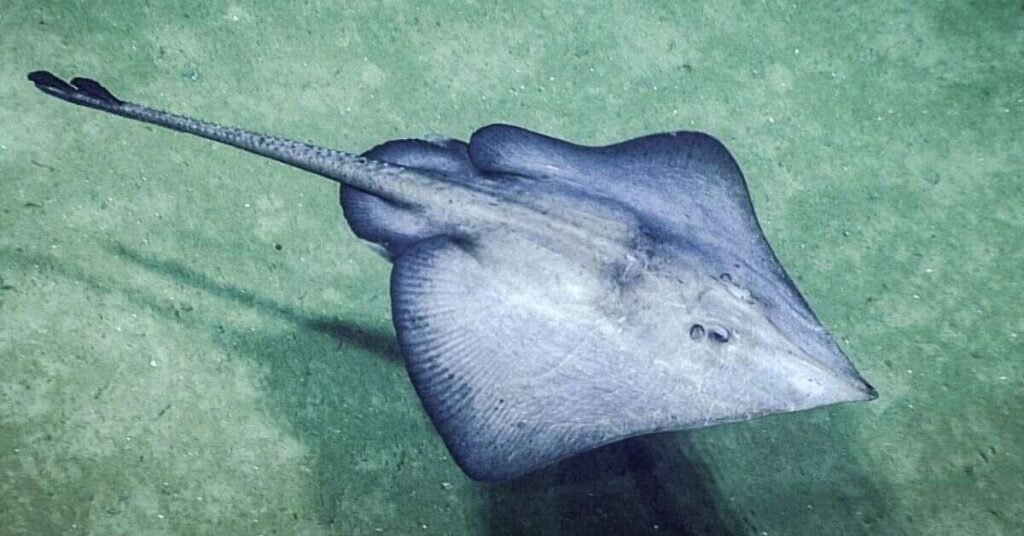
The Pacific white skate has the flat body shape commonly associated with skates and rays. Its wide body helps it move close to the seafloor.
Its pale coloration is one of its most noticeable features. The species also has large eyes that suit its deep-water environment.
Skates are cartilaginous fish. This means their skeletons are made mainly from cartilage rather than hard bone. Sharks also have cartilaginous skeletons, which is why skates are often described as shark relatives.
The body shape of a skate may look simple, but it works well for life close to the ocean floor.
The broad fins help the animal move through deep water. Its tail extends behind the body and contains structures that differ from those of typical bony fish.
The Pacific white skate is not an animal people commonly encounter. Its extreme depth makes sightings rare. Most information about it comes from scientific surveys, deep-sea exploration and specimens collected during research operations.
Scientists have also used genetic testing to confirm species identification. This can be especially useful when deep-sea skates look similar to related species.
How Does the Pacific White Skate Survive in the Deep Sea?
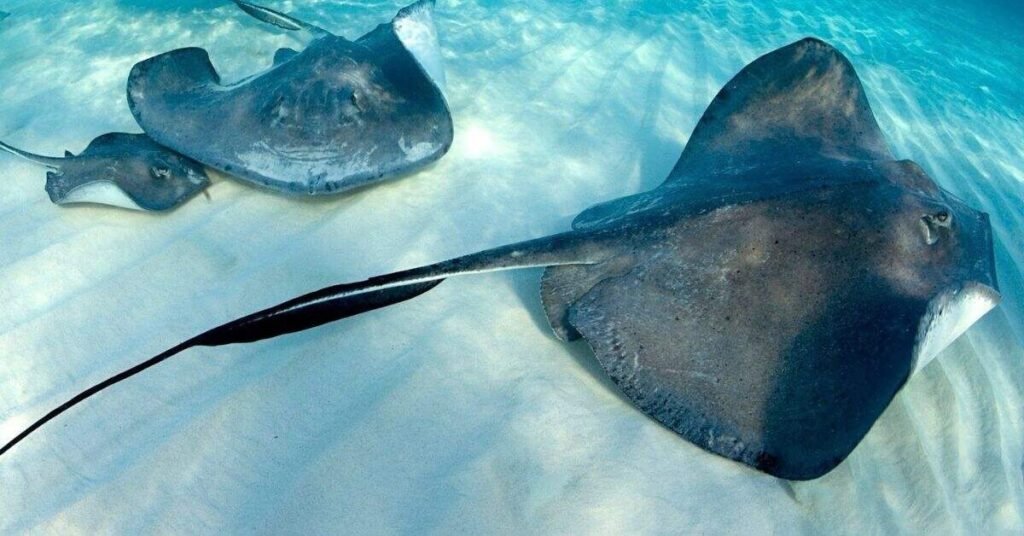
The deep ocean creates several major challenges for animals.
There is almost no sunlight at great depths. Temperatures are generally very low, and pressure increases dramatically as depth increases.
The Pacific white skate has adapted to this environment over evolutionary time.
Its flattened body allows it to live close to the seafloor. Like other deep-sea animals, it also has a lifestyle suited to conditions that are very different from those at the surface.
Food availability can vary greatly in deep water. The Pacific white skate likely feeds on animals living on or near the seafloor, although researchers still have much to learn about the species’ exact diet and feeding behavior.
This lack of information is important. Scientists have studied only a small part of the deep ocean in detail. Some species are known from only a limited number of observations.
The discovery of Pacific white skate nurseries shows how much can still be learned through deep-sea exploration.
ROVs are especially useful because they allow researchers to observe animals without bringing them to the surface. They can record video, collect samples and measure environmental conditions around the animals.
Why Are Hydrothermal Vents Important?
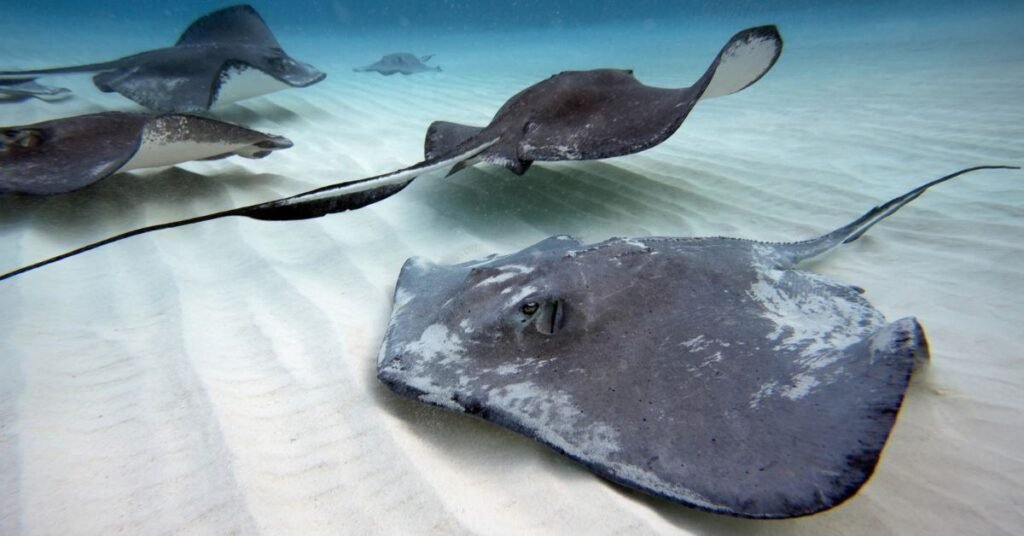
Hydrothermal vents are among the most unusual habitats on Earth.
They form where seawater interacts with hot rocks beneath the seafloor. The heated water can carry minerals and chemicals back into the ocean.
These environments support communities of animals even though sunlight does not provide the main source of energy.
Microorganisms around vents can use chemical energy in a process called chemosynthesis. These microorganisms form the base of food webs that support other animals.
Scientists first discovered hydrothermal vent ecosystems in the late 1970s. Since then, researchers have found many unusual organisms living around them.
The discovery involving the Pacific white skate added another important function to these habitats.
The vents are not only places where unusual animals live. They can also act as nursery areas.
This changes how scientists understand deep-sea ecosystems. A hydrothermal vent can provide conditions that are useful for reproduction even when the surrounding ocean is extremely cold.
Researchers have also found skate eggs near cold seeps. Cold seeps resemble hydrothermal vents in some ways but do not provide the same heat. This suggests that skate reproduction may involve several types of special deep-sea habitats.
Threats Facing the Pacific White Skate
The remote habitat of the Pacific white skate does not make it completely safe from human activity.
Deep-sea ecosystems face several potential pressures. Fishing can affect deep-water species, while industrial activity can disturb parts of the seafloor.
Hydrothermal vents have also attracted interest because of the minerals found around them. Deep-seabed mining can physically disturb areas that may contain unique ecosystems and species.
For the Pacific white skate, reproductive habitats may be especially important.
If eggs take several years to develop, losing an important nursery area could have long-term effects. Long development periods can also make populations slower to recover from heavy losses.
However, scientists still need more information about the species’ population size, movements and reproductive patterns.
That is why research matters.
Protecting deep-sea habitats requires scientists to first understand what lives there and how those animals use their environment. Discoveries about the Pacific white skate show that even small areas around underwater geological features can have important biological roles.
Why the Pacific White Skate Matters
The Pacific white skate matters because it provides scientists with a rare look at how life can adapt to extreme environments.
Its relationship with hydrothermal vents is particularly valuable for understanding deep-sea reproduction.
The species also reminds us that the ocean contains habitats that remain poorly understood. An area that appears empty from the surface may contain important breeding grounds below.
The discovery of Pacific white skate egg nurseries also shows why exploration can change scientific knowledge.
Before researchers observed the behavior, hydrothermal vents were mainly known for supporting unusual communities of animals and microorganisms. Finding skate eggs there revealed another possible ecological role.
Research into the Pacific white skate can therefore contribute to broader knowledge about marine ecosystems.
It may also help scientists understand how deep-sea animals respond to changes in temperature, habitat and food availability.
For wildlife enthusiasts, the species offers another example of how surprising nature can be. Life does not always use familiar environments in familiar ways.
Sometimes, an animal finds an opportunity in one of the most extreme places on Earth.
Frequently Asked Questions
What is the Pacific white skate?
The Pacific white skate is a deep-sea fish known for its pale body and flattened shape. It lives in deep parts of the Pacific Ocean.
Where does the Pacific white skate live?
The Pacific white skate lives in deep Pacific waters, including areas around the Galápagos and Alaska. It can live at depths of nearly 2,900 meters.
What does the Pacific white skate eat?
The Pacific white skate likely feeds on small animals and other organisms found on or near the deep ocean floor, although its exact diet needs more study.
Why does the Pacific white skate lay eggs near hydrothermal vents?
It appears to use the warmer water around hydrothermal vents to help its eggs develop faster in the normally cold deep sea.
How long do Pacific white skate eggs take to hatch?
Pacific white skate eggs may take more than four years to hatch under deep-sea conditions, although researchers still need more direct data on their exact incubation time.
Conclusion
The Pacific white skate is one of the most fascinating animals found in the deep Pacific Ocean. It lives in darkness, extreme pressure and near-freezing water, yet it has developed a remarkable reproductive strategy.
The discovery of its eggs around hydrothermal vents was especially important. Scientists found evidence that these unusual geological features can serve as natural incubation sites for skate eggs.
The story of the Pacific white skate also demonstrates how much remains unknown beneath the ocean surface. Deep-sea exploration continues to reveal animals, habitats and behaviors that challenge our understanding of marine life.
Protecting these habitats starts with learning more about them. Continued research can help scientists understand where Pacific white skates reproduce, how their eggs develop and how human activities may affect their habitat.
For now, the Pacific white skate remains a powerful example of nature’s ability to adapt. In one of the darkest and harshest environments on Earth, this unusual skate has found a way to use the warmth of the planet itself to give its young a better chance to develop.
