

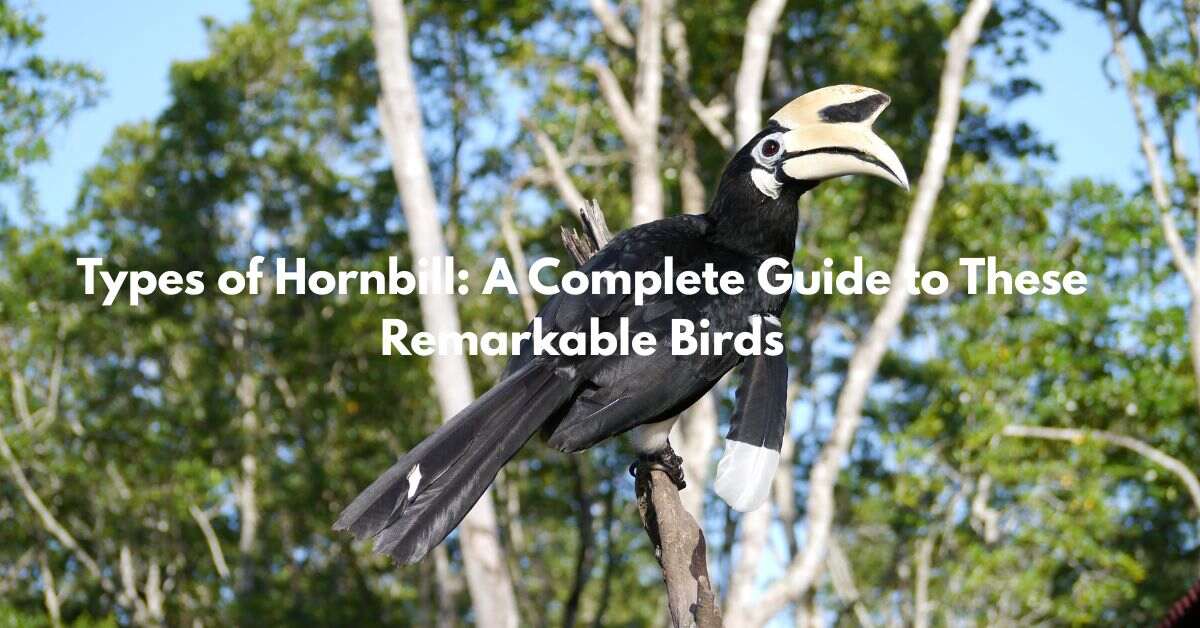
Have you ever seen a bird that looks like it’s wearing a helmet? That’s probably a hornbill, one of nature’s most unusual and fascinating creatures.
These extraordinary birds have captured human imagination for centuries with their massive curved bills and distinctive casques perched on top.
From the dense rainforests of Southeast Asia to the open savannas of Africa, hornbills have evolved into 62 unique species, each adapted to its own special environment.
Understanding the different types of hornbill helps us appreciate their critical role in forest ecosystems and why protecting them matters so much for our planet’s future.
What Makes Hornbills Unique Among Birds
Hornbills belong to the families Bucerotidae and Bucorvidae, and they stand out in the bird world for several remarkable reasons.
Their most obvious feature is the large, curved bill topped with a structure called a casque. This helmet-like growth sits on the upper part of the bill and varies dramatically between species.
The casque serves multiple purposes. In many species, it acts as a resonating chamber that makes their calls louder and more impressive. Some hornbills use it to attract mates, while others rely on it for support when digging through bark or soil.
What really sets hornbills apart from all other birds is their skeleton. They are the only birds where the first two neck vertebrae are completely fused together. This unique adaptation provides a stable platform for carrying their heavy bills.
Their nesting behavior is equally unusual. Female hornbills seal themselves inside tree cavities during breeding season, with only a small opening for the male to pass food through. This protects the mother and chicks from predators while they’re most vulnerable.
14 Types of Hornbills: Asian and African Species
Asian Hornbill Species
Asia is home to 32 types of hornbill species, each displaying unique characteristics and behaviors that help them thrive in tropical environments.
1. Great Hornbill
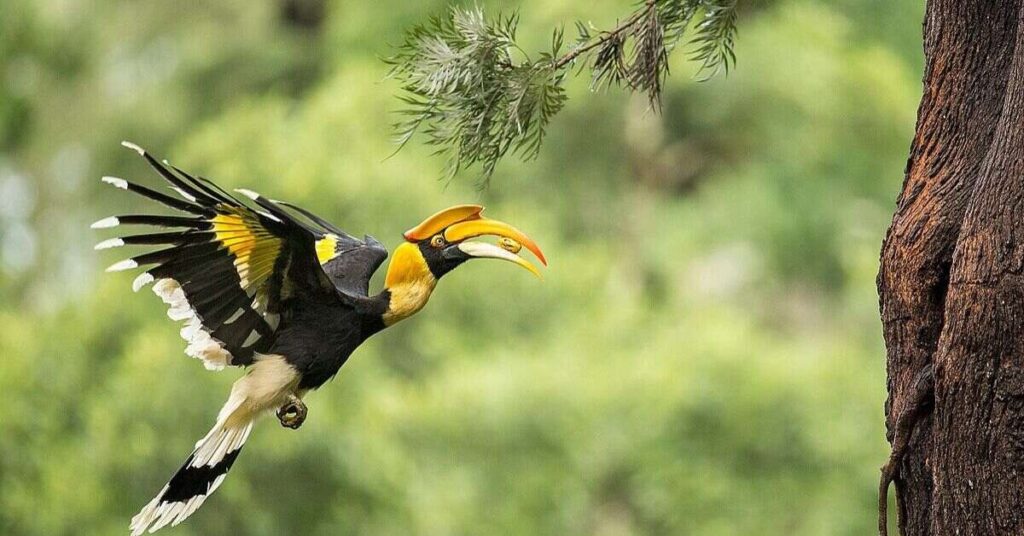
The Great Hornbill stands as one of the largest and most impressive species in Asia. This magnificent bird can reach lengths up to 130 centimeters with a wingspan exceeding 1.5 meters.
Found across India, Southeast Asia, and southern China, the Great Hornbill sports a massive yellow and black casque that can weigh up to 10 percent of its total body weight.
These birds prefer primary forests and play a crucial role as seed dispersers. They consume over 100 different fruit types throughout the year, especially figs, and carry seeds far from parent trees.
The Great Hornbill is currently listed as Vulnerable due to habitat loss and hunting pressure across its range.
2. Rhinoceros Hornbill
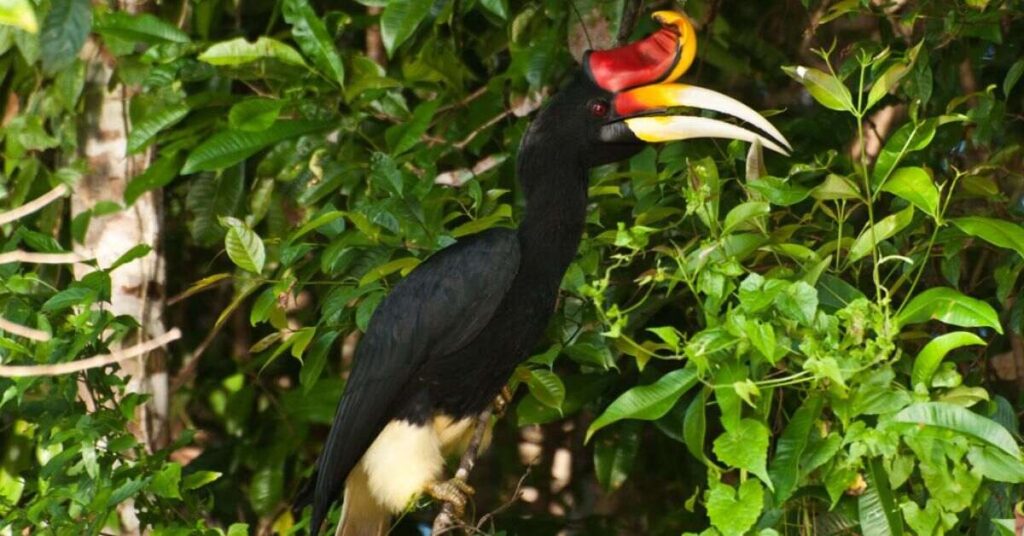
The Rhinoceros Hornbill serves as Malaysia’s national bird and represents one of the most visually striking species. Its prominent orange and red casque curves upward like a rhinoceros horn, giving this species its common name.
These birds inhabit lowland forests of Borneo, Sumatra, Java, and the Malay Peninsula. They weigh between 2,180 and 2,580 grams and can reach impressive sizes.
The Iban people of Borneo regard the Rhinoceros Hornbill as the king of worldly birds. They use its statue to welcome spirits during important ceremonies and celebrations.
Their diet consists mainly of fruits, especially figs, but they also consume insects, small reptiles, rodents, and smaller birds when available.
3. Helmeted Hornbill
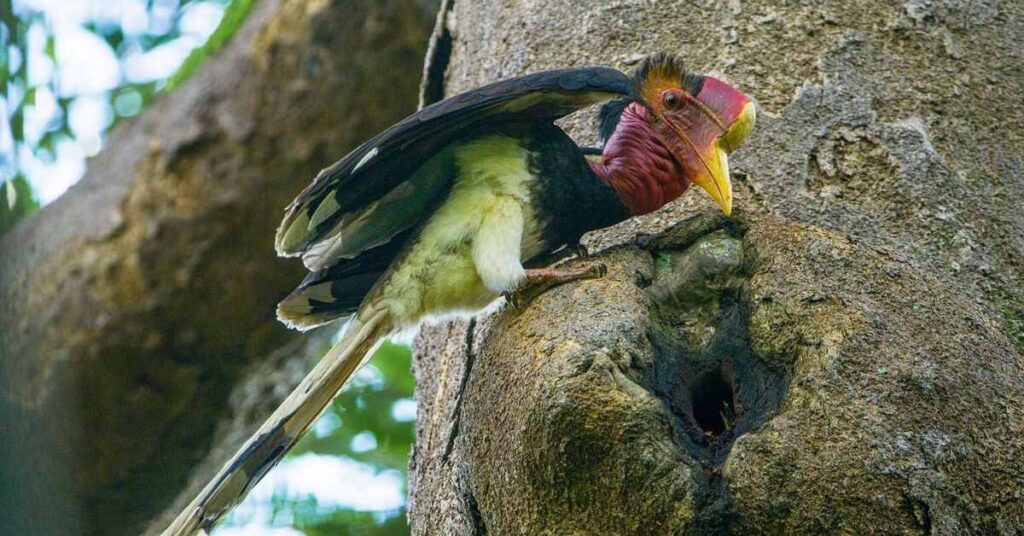
The Helmeted Hornbill is a rare bird from Southeast Asia. It lives in rainforests. This bird is famous for its unusual head. It has a solid casque on top of its beak. The casque is made of keratin. It looks like a helmet. The bird is quite large.It can grow up to 1.2 meters in length. Males and females look different. Males have red skin around their eyes and throat. Females have blue skin in these areas.
This hornbill is critically endangered. People hunt it for its casque. The casque is called “red ivory.” Traders sell it illegally. Habitat loss also threatens the bird. Loggers are cutting down rainforests. The bird needs old trees with large holes for nesting. It eats mostly figs.In the forest, birds play an important role. As it eats fruits, it spreads seeds.
Conservation groups are working to protect it. They patrol forests to stop poachers. They also work with local communities. Saving this bird is urgent.
4. Wrinkled Hornbill
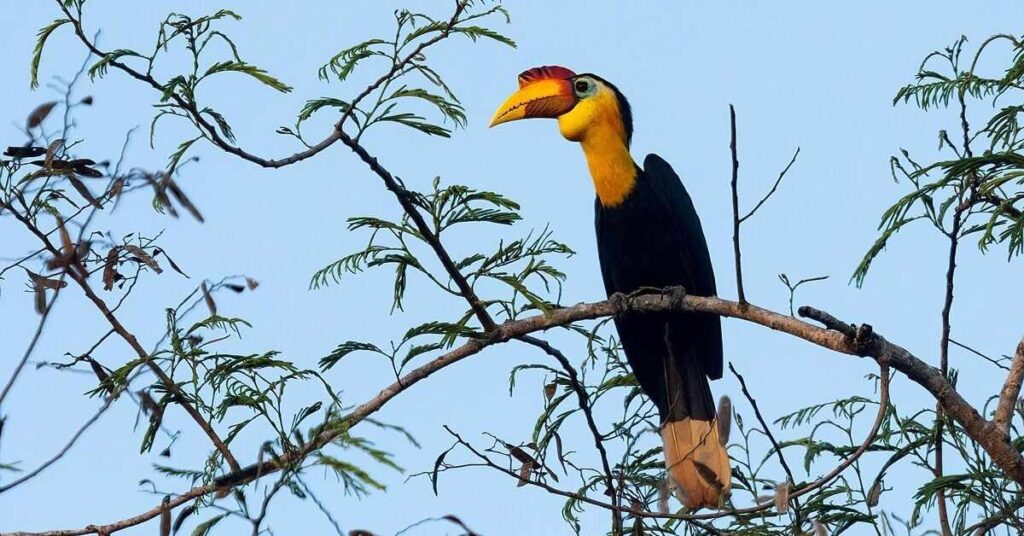
The Wrinkled Hornbill is a medium-sized bird from Southeast Asia. It lives in lowland and hill forests. This bird has dark feathers that appear black or brown. The males have a blue throat pouch. The pouch has wrinkled skin, which gives the bird its name. Females have a yellow or white throat. Both have a casque on top of their beaks. The casque is ridged and yellowish. These birds are shy and hard to spot in the wild. They prefer to stay high in the forest canopy. Their calls sound like loud barks or yelps.
Wrinkled Hornbills feed mostly on fruits. They especially like figs and berries. They also eat insects and small reptiles. These birds help spread seeds throughout the forest. They nest in hollow trees like other hornbills. The female seals herself inside during breeding season. The male brings food to her and the chicks. This species is endangered in many areas. Logging destroys their forest homes. Hunting also threatens their survival. The birds need large forest areas to survive. Conservation efforts focus on protecting their habitats. Some countries have created wildlife reserves for them. Educating local communities is also important for their protection.
5. Oriental Pied Hornbill
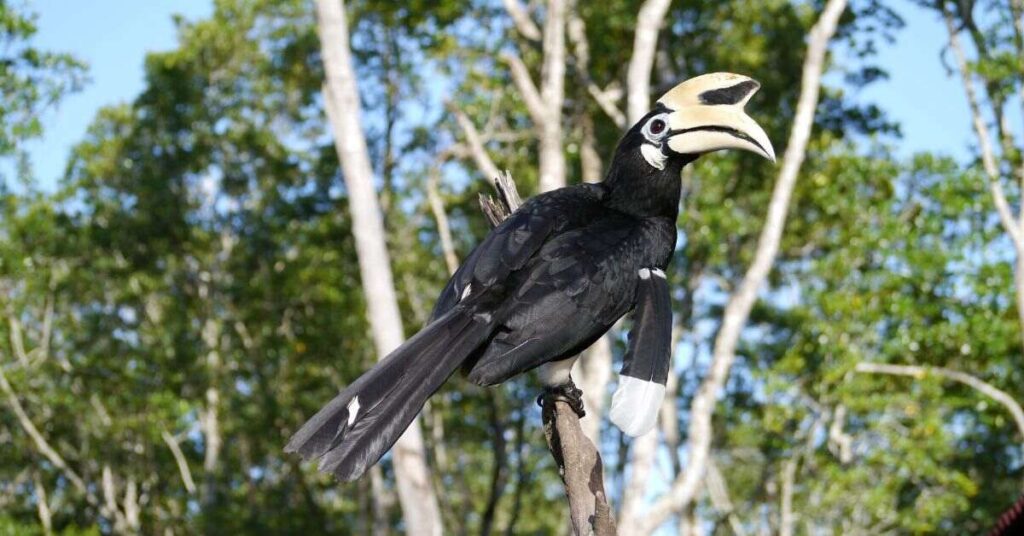
The Oriental Pied Hornbill ranks among the smaller and most adaptable Asian hornbills. This black and white bird displays a prominent cream-colored casque and remarkable resilience to habitat changes.
Unlike many hornbill species, Oriental Pied Hornbills successfully inhabit both primary forests and secondary growth areas. They’ve even adapted to urban parks and gardens in cities across Thailand and Malaysia.
Their adaptability has helped maintain stable populations in many regions, though they still face pressure from habitat conversion and hunting.
These birds range from northern India through Southeast Asia to Java and Bali. They prefer forest edges and coastal lowlands up to 700 meters in elevation.
Helmeted Hornbills have long tail feathers that can extend 30 to 45 centimeters. They inhabit primary lowland rainforests in Brunei, Indonesia, Malaysia, Myanmar, and southern Thailand.
6. Wreathed Hornbill
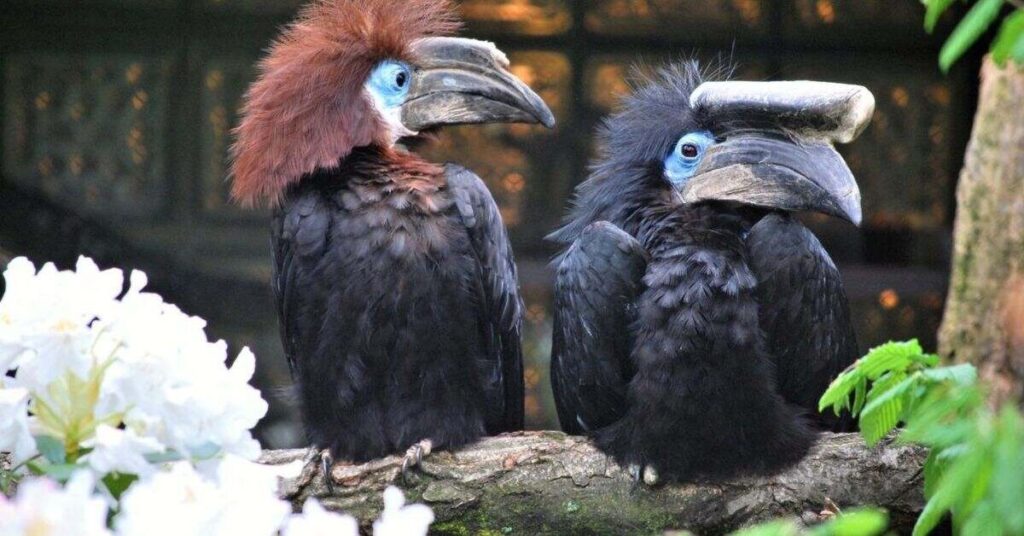
The Wreathed Hornbill inhabits the dense canopies of Borneo and Sumatra. Males feature distinctive white throat pouches that inflate during vocalizations.
These birds display unique ridged casques that look like carved wreaths sitting on top of their bills. Males have brick red crowns and napes with cream-colored faces and necks.
The diet of Wreathed Hornbills is particularly interesting. Since they consume more fruit than most other hornbill species, they play an important role in forest regeneration and seed dispersal.
They occur in primary rainforests, mainly in foothill areas, and can be found at elevations up to 3,300 meters above sea level.
Read about it more : https://www.wildlifenomads.com/blog/types-of-hornbills/
African Hornbill Species
Africa hosts 30 species of hornbills, split almost equally between forest dwellers and birds of more open habitats.
7. Southern Ground Hornbill
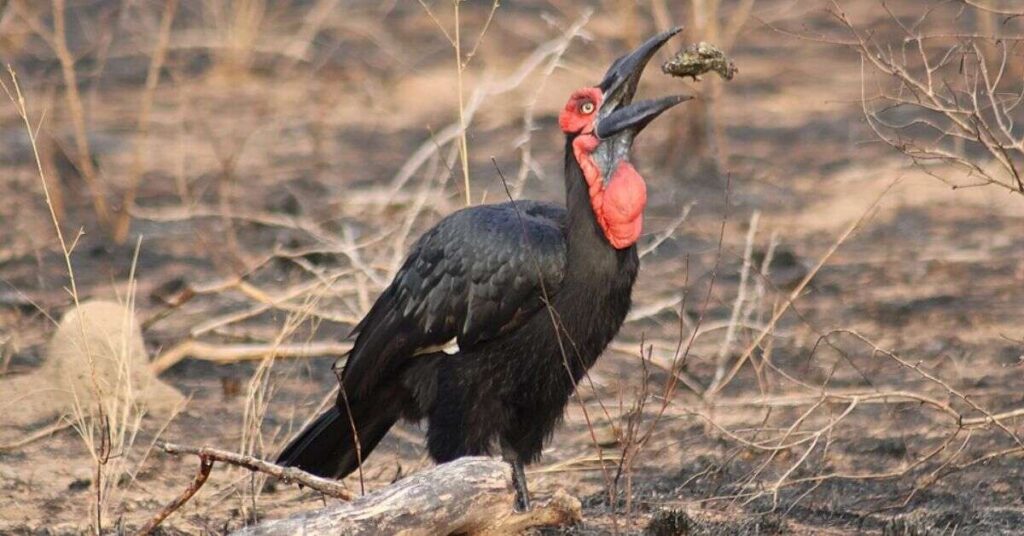
The Southern Ground Hornbill holds the title as the largest hornbill species worldwide. These impressive birds stand at three feet tall with a four-foot wingspan and can weigh up to 6.3 kilograms.
Unlike most hornbills that spend their lives in trees, Southern Ground Hornbills are primarily terrestrial. They walk across the savanna in small family groups of up to a dozen individuals.
Their diet differs completely from tree-dwelling species. These carnivorous birds eat mice and other rodents, frogs, insects, and even venomous snakes, which they catch using their long bills as tongs.
The species is classified as Vulnerable on the IUCN Red List and Endangered in South Africa. Population declines result from persecution and loss of suitable nesting habitat.
8. Northern Ground Hornbill

The Northern Ground Hornbill, also called the Abyssinian Ground Hornbill, occupies territories north of the equator. These birds range from southern Mauritania and Senegal across to Ethiopia and northwestern Kenya.
Female birds are easily distinguishable by their all-blue facial skin. Males have an inflatable patch of red skin on their necks and throats.
Like their southern relatives, these birds patrol their territories on foot. They’re capable fliers but prefer walking while hunting for insects, reptiles, and small mammals.
They favor woodland and savanna habitats with short grass for foraging and suitable large trees for roosting and nesting.
9. Abyssinian Ground Hornbill
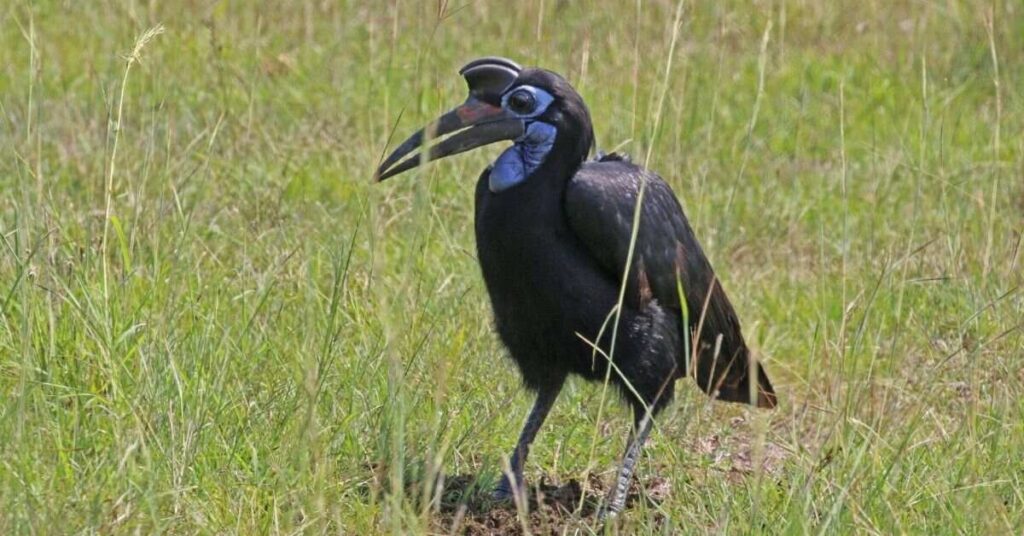
The Abyssinian ground hornbill is one of the largest hornbill species found in Africa. It lives in open grasslands and dry savannas. This bird spends most of its time walking on the ground instead of flying. It has black feathers, long legs, and a strong curved bill. Males have a bright red throat pouch, while females show a mix of blue and red. Its deep booming call can travel long distances. People can often hear it before they see it.
This hornbill eats insects, small reptiles, and rodents. It helps control pests in its habitat. The Abyssinian ground hornbill lives in family groups and shows strong bonding. Young birds stay with their parents for many years. This bird needs large open areas to survive. Habitat loss and farming reduce its living space. Protecting grasslands helps keep this unique hornbill safe for the future.
10. Silvery-cheeked Hornbill
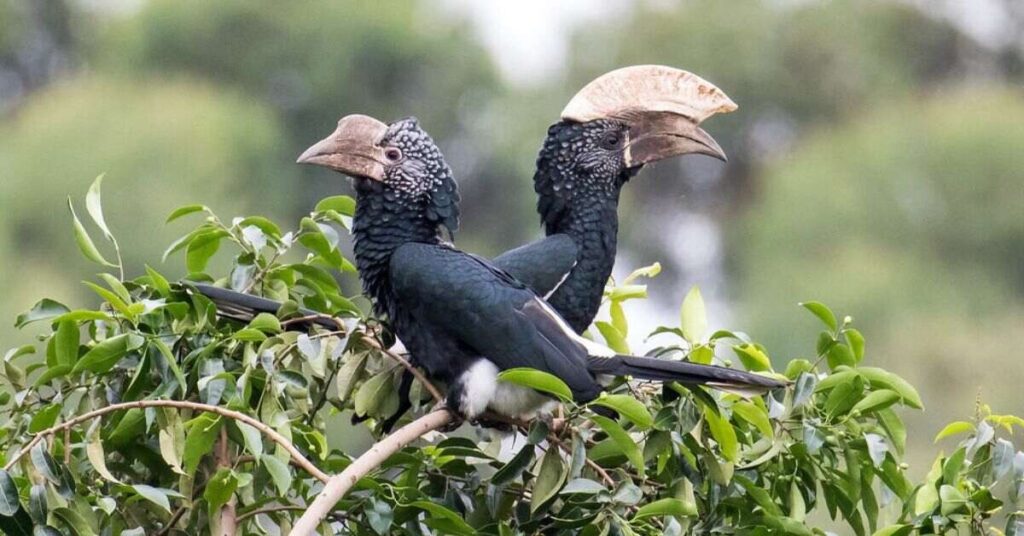
The silvery-cheeked hornbill is a large and beautiful bird found in East Africa. It lives in coastal forests and mountain woodlands. This bird has dark feathers and bright silver patches on its cheeks. Its large curved bill stands out clearly. The silvery-cheeked hornbill often flies across long distances in search of food. Its presence shows a healthy forest environment.
This hornbill mainly eats fruit, especially figs. It also eats insects at times. By spreading seeds, it helps forests grow and stay strong. The silvery-cheeked hornbill nests in tree holes high above the ground. The female stays inside the nest while the male brings food. Forest cutting threatens its survival. Protecting natural forests helps this hornbill thrive.
11. White-thighed Hornbill
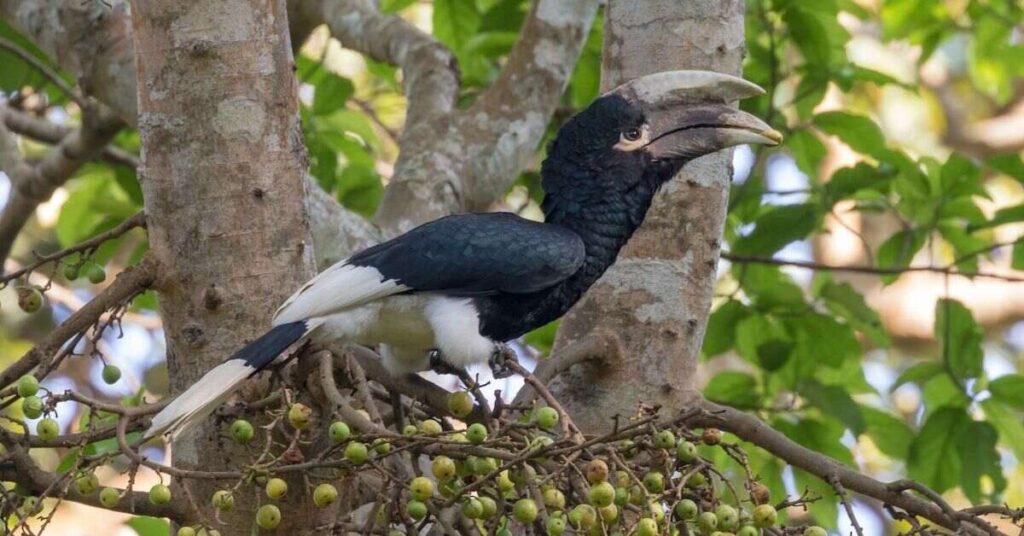
The white-thighed hornbill is a large forest bird found in West and Central Africa. It lives in dense rainforests and tall woodland areas. This bird has mostly black feathers with clear white patches on its thighs. Its strong curved bill helps it feed easily. The white-thighed hornbill often moves in pairs or small groups. Its loud calls echo through the forest canopy.
This hornbill mainly eats fruit, especially figs and berries. It also eats insects when fruit is scarce. By spreading seeds, it helps forests stay healthy. The white-thighed hornbill nests in tree cavities high above the ground. The female seals herself inside the nest while the male brings food. Forest loss threatens this species. Protecting old trees helps keep this hornbill safe.
12. Black-and-white-casqued Hornbill
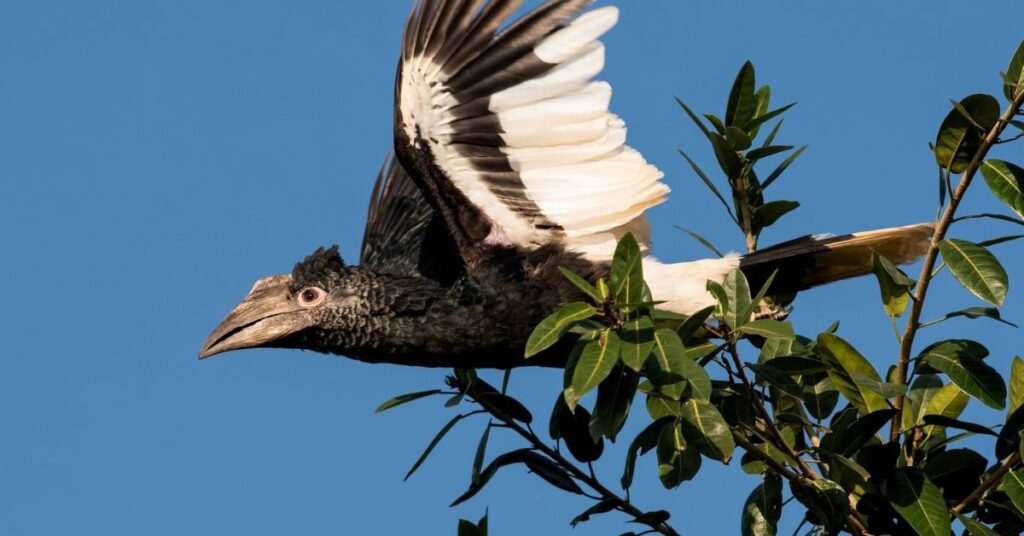
The black-and-white-casqued hornbill is a striking bird found in African forests. It lives in tropical rainforests and dense woodlands. This bird has black feathers with bright white markings on its wings and tail. Its large bill carries a clear casque on top. The casque helps the bird produce loud calls. These calls travel far through the forest.
This hornbill mainly eats fruit, especially figs. It also eats insects at times. By eating fruit, it spreads seeds across wide areas. This helps forests grow naturally. The black-and-white-casqued hornbill nests in tree holes. The female stays inside the nest while the male brings food. Forest destruction threatens this species. Protecting forests helps this hornbill survive.
13. Yellow-casqued Hornbill
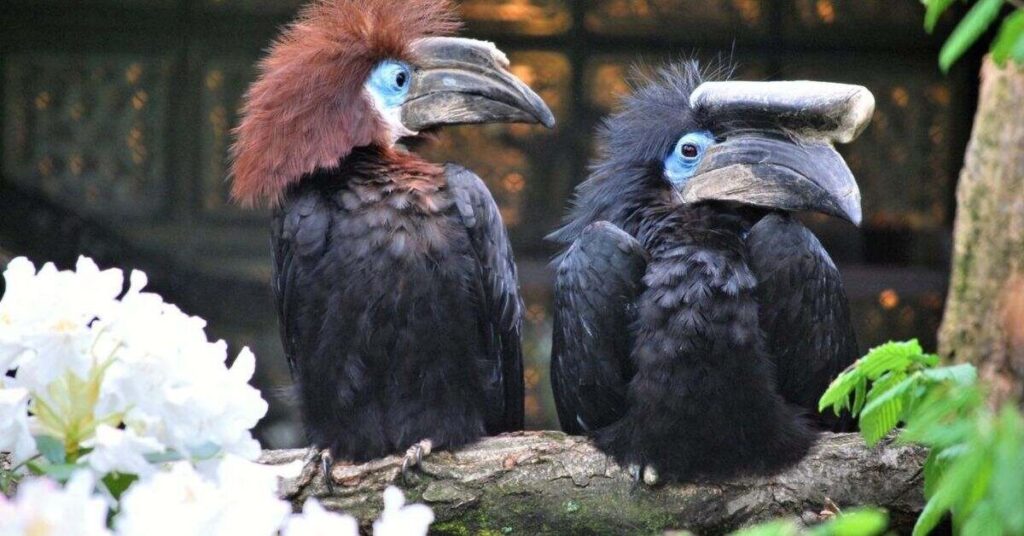
The yellow-casqued hornbill is a large forest bird found in Central and West Africa. It lives in dense tropical rainforests with tall trees. This bird has dark feathers and a bright yellow casque on its bill. The casque makes it easy to recognize. The yellow-casqued hornbill often flies high above the forest canopy. Its deep calls can be heard from far away.
This hornbill mainly eats fruit, especially figs. It also eats insects when needed. By spreading seeds, it helps forests stay healthy. The yellow-casqued hornbill nests in tree cavities. The female stays inside the nest while the male brings food. Forest loss threatens this species. Protecting rainforests helps the yellow-casqued hornbill survive.
14. Trumpeter Hornbill
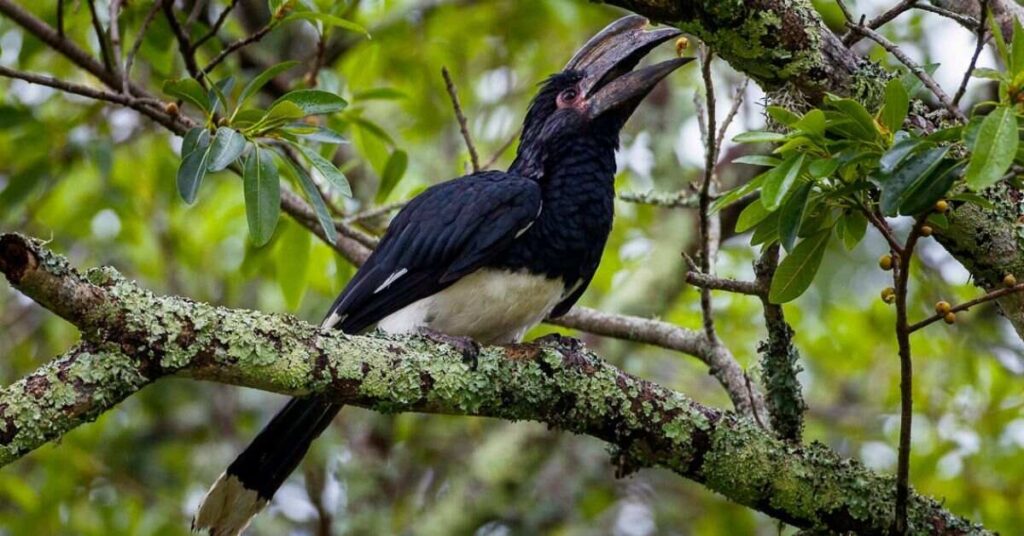
The Trumpeter Hornbill lives in forests and has mostly black plumage with a white belly. Its large black down-curved bill and conspicuous casque make it easy to identify.
The casque in this species is particularly pronounced and serves an additional purpose in amplifying its calls. This gives the bird its trumpet-like vocalizations.
Trumpeter Hornbills are omnivorous. Their diet consists of large insects, crabs, eggs, nestlings, reptiles, small birds, and various fruits, especially figs and fruits from the Natal Mahogany tree.
They can spend extended periods foraging in productive fruiting trees, working systematically through the canopy.
Hornbill Habitats and Distribution
Hornbills are found exclusively in Africa and Asia, with no species naturally occurring in the Americas, Australia, or Europe.
Their distribution stretches from sub-Saharan Africa across the Indian subcontinent to Southeast Asia, reaching the Philippines and Solomon Islands in the east.
No hornbill genus is found in both Africa and Asia. This geographical separation has led to distinct evolutionary paths on each continent.
Most Asian hornbill species inhabit tropical and subtropical forests. They range from dense rainforests in Borneo to deciduous forests in India.
Some species, like the Oriental Pied Hornbill, have adapted to secondary forests and even urban environments. Others, such as the Helmeted Hornbill, require pristine primary forest to survive.
African hornbills show even greater habitat diversity. While forest species like the Trumpeter Hornbill stick to dense woodland environments, ground hornbills have carved out successful niches in open savannas and grasslands.
Forest-dwelling hornbills prefer areas with tall, mature trees that provide suitable nesting cavities. These large tree hollows are essential for their unique breeding behavior.
The availability of fruiting trees heavily influences hornbill distribution. Many species follow seasonal fruiting patterns, moving through forests to find food resources.
Unique Hornbill Behaviors and Adaptations
Hornbills display some of the most unusual breeding behaviors in the bird world. This nesting strategy sets them apart from virtually all other bird species.
When ready to breed, the female enters a tree cavity and, with help from the male, walls herself inside. She uses mud, droppings, and fruit pulp to create a cement-like seal.
Only a narrow slit remains open. Through this opening, the male passes food to the female and later to the growing chicks.
This behavior protects the vulnerable family from predators like snakes and monkeys. The female remains sealed inside until the chicks are partially grown.
During this confinement, the female molts and grows a complete new set of feathers. She emerges with fresh plumage when the chicks are ready to leave the nest.
The male’s devotion during this period is remarkable. He must faithfully deliver food to his family for weeks or even months without rest.
To keep the nest clean, the female defecates at high speed through the small opening. As chicks grow, they learn to do the same. Beetles and ants clean up other debris inside the cavity.
Hornbills also serve as important seed dispersers in their ecosystems. They’re often called the gardeners of the rainforest because of this crucial role.
After eating fruits, hornbills can carry seeds dozens of kilometers from parent trees. Their large gape width allows them to swallow fruits too big for other birds.
This seed dispersal helps maintain forest diversity and promotes regeneration. Some tree species depend almost entirely on hornbills for spreading their seeds to suitable growing sites.
Conservation Status and Threats
Many types of hornbill are now at risk due to human activities. Deforestation is the biggest threat. Cutting down trees removes food sources and nesting sites. Some hornbills are also hunted for meat, feathers, or cultural items. Climate change affects fruit availability and forest health. These factors make survival difficult for hornbills in many regions.
Conservation status varies among species. Some hornbills are listed as vulnerable or near threatened. Ground hornbills and forest hornbills face the most danger. Habitat protection and legal enforcement are key to their survival. Community education and eco tourism also help reduce threats. Saving hornbills requires protecting forests and raising awareness worldwide.
Conservation Efforts and Success Stories
Many organizations work to protect hornbills and their habitats. They focus on saving forests and reducing hunting. Local communities are taught the importance of hornbills for nature. Protected areas and national parks provide safe homes for these birds. Researchers also study hornbill behavior to improve conservation plans. These efforts help slow population decline and protect key species.
Some hornbill conservation projects have shown great success. In certain forests, populations of great hornbills and rhinoceros hornbills are increasing. Planting native trees provides food and nesting sites. Community awareness programs reduce illegal hunting. Eco tourism also supports local protection efforts. These success stories show that focused action can save hornbills and preserve forests for the future.
Hornbill Diet and Feeding Ecology
Hornbills have a varied diet that depends on their habitat. Most hornbills eat fruit, especially figs, which provide energy and nutrients. Some species also eat insects, small reptiles, and rodents. This mixed diet helps them survive when fruit is scarce. Ground hornbills hunt more on land, while forest hornbills search in trees. By eating different foods, hornbills balance their energy needs and support forest health.
Feeding habits of hornbills play an important role in nature. When hornbills eat fruit, they carry seeds far from the parent tree. This helps new trees grow in different areas. Some hornbills feed in groups, which increases food finding efficiency. Their feeding ecology also affects other animals in the ecosystem. Healthy hornbill populations indicate a strong and balanced forest environment.
Physical Characteristics of Different Hornbill Types
Different hornbill types show many unique physical features. Most hornbills have large curved bills that help them pick fruit and catch prey. Many species have a casque on top of the bill. The casque can be small or very large. Its size and shape differ between hornbill types. Some hornbills have bright colors on their bills and faces. Others show simple black and white feathers. These features help them recognize each other in the wild.
Hornbills also differ in body size and shape. Forest hornbills usually have broad wings for long flights. Ground hornbills have long legs for walking on land. Some hornbills have long tails that help with balance. Males and females may look different in color or size. These physical traits help each hornbill type survive in its own habitat.
Hornbill Cultural Significance
Many cultures across Asia and Africa hold hornbills in special regard, incorporating them into traditions, ceremonies, and spiritual beliefs.
The Iban people of Borneo consider the Rhinoceros Hornbill as the king of worldly birds. They believe it acts as an intermediary between humans and the spirit world.
During Gawai Kenyalang celebrations, the Iban erect large painted figures of hornbills on tall poles. These statues symbolize the hornbill spirit carrying messages from humans to the upper spirit realm.
The Rhinoceros Hornbill serves as the state bird of Sarawak in Malaysia and is the country’s national bird.
In many Southeast Asian cultures, hornbills represent strength, courage, and fidelity. Their monogamous pair bonds and devoted parenting inspire these associations.
Some Indigenous groups use hornbill feathers and casques in traditional ceremonies and regalia. However, sustainable practices have given way to destructive poaching in many areas.
African cultures also recognize hornbills’ importance. The Southern Ground Hornbill appears in folklore and traditional stories across its range.
Unfortunately, cultural significance can sometimes drive demand for hornbill parts. The illegal trade in helmeted hornbill casques stems partly from demand for carved ornamental items.
Conservation efforts increasingly work with traditional communities to maintain cultural connections while protecting living hornbills. This approach respects heritage while ensuring species survival.
How to Support Hornbill Conservation
You can help protect hornbills in many ways. Start by learning more about these birds. Share information with friends and family. Support organizations that work to save hornbills. You can donate money to conservation groups. Even small amounts help fund protection efforts. Avoid buying products made from hornbill parts. Never purchase red ivory or hornbill casques. This trade threatens their survival. Choose sustainable palm oil and wood products. This helps protect their forest homes. Reduce your paper use to save trees. Hornbills need old forests with large trees for nesting.
You can also raise awareness on social media. Post about hornbill conservation issues. Sign petitions that protect wildlife and forests. Visit ethical zoos that support breeding programs. These programs help increase hornbill numbers. If you travel to Southeast Asia, choose eco-friendly tours. Support local communities that protect forests. Report any illegal wildlife trade you see. Teach children about the importance of hornbills. Future generations need to care about these birds. Every action counts toward saving hornbills. Together we can make a real difference. These amazing birds deserve our protection and respect.
Conclusion
The many types of hornbill found across the world show how rich and diverse nature can be. From African savannas to Asian rainforests, hornbills adapt in amazing ways. Their unique bills and behaviors make them special among birds.
Hornbills play a vital role in keeping forests healthy. They spread seeds and support plant growth. Without them, many forests would struggle to survive.
Protecting hornbills protects entire ecosystems. It also protects the future of wildlife. By learning about hornbills and sharing their story, we take one step closer to a healthier planet.
FAQs
What are the most common types of hornbill found in the wild?
The most common types of hornbill include the African grey hornbill, great hornbill, and yellow billed hornbill. These species adapt well to their environments.
Why are hornbills important for forests?
Hornbills spread seeds across large areas. This helps forests grow and stay healthy. Many trees depend on hornbills for regeneration.
Where do hornbills live?
Hornbills live in Africa and Asia. They occupy forests, savannas, and grasslands depending on the species.
Are hornbills endangered?
Some types of hornbill face population decline due to habitat loss and hunting. Conservation efforts aim to protect them.
What do hornbills eat?
Hornbills eat fruits, insects, and small animals. Their diet varies based on habitat and species.
